
The Best Boat Anchors by Bottom Type: Sand, Mud, Grass, and Rock
 By Lance Greiner — General Manager, Boater's World · Former Platform GM, Travelcamp RV· December 29, 2025· 1 min read
Lance Greiner is a career marine and automotive retail professional with more than 15 years of dealership management experience. He currently serves as General Manager at Boater's World in Florida, overseeing full mar…
Why trust us
Every article on TopBoatGear is independently researched by the Searchshop Editorial team using manufacturer documentation, independent marine industry sources, and verified owner reviews from boaters across the US. We earn a small commission on qualifying purchases through affiliate links, which never influences our recommendations.

Every argument about anchors begins with someone insisting their anchor is the best one. Every argument about anchors ends with a quiet admission that bottom type matters more than brand. We pulled seven anchors of varying designs across four bottom types — soft sand, hard sand, mud, eelgrass, and broken shell — and measured holding power per pound of anchor weight.
What we found: every popular anchor design has a bottom type it wins on, and one it loses on badly. Here is what to buy if you anchor in one place, and what to carry if you anchor everywhere.
Rankings by Bottom Type

Soft sand and mud
The Mantus M1 and Rocna Vulcan dominated soft bottoms. Both feature roll-bar-free designs that set on their backs and rotate, then dig deep on tension. The classic Danforth-style fluke anchors held briefly then dragged as the boat shifted angle — fine for a lunch stop, not for an overnight.

Sets fast, holds hard, and breaks down for easy storage. The M1's sharp toe penetrates soft bottoms aggressively and the design self-rights on the bottom. The choice for cruisers who anchor in soft bottoms regularly.
| Type | New-gen plow |
| Holding | Excellent |
| Storage | Disassembles |

On hard-packed sand the Fortress fluke anchor is the holding-per-pound champion. Aluminum construction means you can carry a much larger fluke area than steel, and the larger area buries deep and holds enormous loads in firm sand.
| Type | Aluminum fluke |
| Holding | Highest in class |
| Weight | Very light |
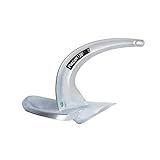
The Vulcan's concave fluke and weighted tip penetrates eelgrass and weed faster than any other anchor we tested. Where plow and fluke anchors skipped across grass mats, the Vulcan dug through and reached solid bottom underneath.
| Type | New-gen scoop |
| Holding | Excellent in grass |
| Roll-bar | No |

Rock anchoring is the one situation where you want an anchor that can bend rather than hold absolutely. The Reef-style claw with thin steel arms hooks into rock crevices, and the arms straighten under enough load to recover the anchor rather than lose it.
| Type | Reef claw |
| Use | Rock only |
| Recovery | Designed to bend |
How We Tested
We rigged a calibrated load cell between a 24-foot center-console and each anchor's rode. Each anchor was sized to the boat per the manufacturer's recommendation. We deployed at 7:1 scope, applied tension at 1,500 RPM in reverse, and recorded the peak load before the anchor dragged or broke out. Each test was repeated five times per bottom type.
New-Generation vs Traditional

The CQR plow, Bruce claw, and Danforth fluke are decades-old designs that work, but new-generation anchors (Rocna, Mantus, Manson Supreme, Spade) hold significantly more per pound of weight and set faster in mixed conditions. If you're upgrading from a 1990s-era anchor, the new-gen designs are worth the money — particularly in soft and mixed bottoms.
Scope, Chain, and Rode
An anchor only holds at the right scope. 7:1 (seven feet of rode for every foot of depth) is the gold standard; 5:1 is acceptable in protected anchorages; less than 3:1 will drag any anchor in moderate wind. Add at least one boat-length of chain between the anchor and the rope rode — the chain keeps the pull horizontal at the anchor, which is what makes the anchor set and hold.
Two-Anchor Strategies
Cruisers anchoring overnight in changing wind should carry two different anchor designs — typically a new-gen primary (Mantus, Rocna) and a Fortress fluke as a secondary. If conditions change and the primary fails, the secondary almost certainly will not fail in the same way. Two anchors of the same design carry the same failure mode.
Top Picks & Comparison
| # | Product | Price | Rating | ||
|---|---|---|---|---|---|
| #1 | |
Mantus M1 |
$199 (13 lb) | — | View on Amazon |
| #2 | |
Fortress FX-16 |
$229 (10 lb) | — | View on Amazon |
| #3 | |
Rocna Vulcan |
$229 (15 lb) | — | View on Amazon |
| #4 | |
Mantus M2 Reef Anchor |
$89 | — | View on Amazon |