
The Best Life Jackets for Boating, Fishing, and Watersports in 2026
 By Lance Greiner — General Manager, Boater's World · Former Platform GM, Travelcamp RV· February 24, 2026· 1 min read· Updated Mar 1, 2026
Lance Greiner is a career marine and automotive retail professional with more than 15 years of dealership management experience. He currently serves as General Manager at Boater's World in Florida, overseeing full mar…
Why trust us
Every article on TopBoatGear is independently researched by the Searchshop Editorial team using manufacturer documentation, independent marine industry sources, and verified owner reviews from boaters across the US. We earn a small commission on qualifying purchases through affiliate links, which never influences our recommendations.

Coast Guard data is brutally consistent: roughly 80% of fatal boating accidents involve drowning, and 85% of those victims were not wearing a life jacket. The pattern is so stable that the single biggest safety improvement any boater can make is wearing a PFD that's comfortable enough to keep on all day.
Comfort is what this guide is about. We tested 14 PFDs across six categories — fishing, kayaking, watersports, sailing, offshore, and inflatable everyday — and ranked the ones we actually wanted to keep wearing after eight hours.
The Rankings


The M.I.T. 100 is the inflatable PFD that solved the comfort problem. The Membrane Inflatable Technology eliminates the bulky bladder fold of older designs, the harness sits flat on the shoulders, and the auto-inflation cylinder fires reliably in cold water. The PFD we recommend for any adult who fishes, cruises, or sails.
| Type | Inflatable suspender |
| Buoyancy | 26 lbs |
| Auto/Manual | Both |
| Harness | Yes |
- The most comfortable inflatable PFD made
- Flat profile under foul weather gear
- Annual rearm cylinder is cheap and easy
- Requires annual inspection
- Not for non-swimmers

Designed for kayak fishing but the best fishing PFD made. Tall back panel sits above a kayak seat or boat backrest, ten pockets, attachment points for pliers and tools, and a high cut that keeps the chest free for casting.
| Type | Foam Type III |
| Pockets | 10 |
| Cut | High-back |
| Mesh | Lower back |
- Best pocket layout in fishing PFDs
- Sits above kayak seats
- Mesh lower back stays cool
- Bulky compared to inflatable
- Hot in summer

Ventilated, low-profile, and Coast Guard approved for skiing and tubing. The MoveVent is the PFD you can actually move and breathe in while you're being dragged across the water at 30 mph. The choice for ski boats and wake boats.
| Type | Foam Type III |
| Cut | Athletic |
| Vent panels | Yes |
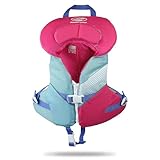
Crotch strap, grab handle on the back, and a high-collar design that flips an unconscious child face-up. The PFD pediatric drowning experts recommend.
| Type | Foam Type II |
| Sizes | Infant, Child |
| Grab handle | Yes |
Built-in AIS personal locator beacon, integrated spray hood, harness rated for cockpit tether, and 170N of buoyancy. The PFD offshore sailors and serious offshore anglers should not save money on.
| Type | Inflatable 170N |
| AIS PLB | Integrated |
| Spray hood | Yes |
| Harness | Yes |
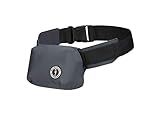
When a vest is too hot — paddleboarding, kayak fishing in summer, dinghy sailing — a belt pack inflatable is the right answer. The Minimalist 28 is the slimmest, most comfortable belt pack made, and the manual pull is intuitive.
| Type | Inflatable belt |
| Activation | Manual |
| Buoyancy | 28 lbs |
The Types of PFDs
The Coast Guard classifies PFDs by performance — Type I (offshore), Type II (near-shore), Type III (flotation aid), Type IV (throwable), and Type V (special use). In 2026 these labels are being phased out in favor of newtonian ratings (50N, 70N, 100N, 150N, 275N), but the practical categories most boaters care about are: foam vests, inflatable belt packs, inflatable suspender PFDs, and offshore lifejackets with hoods and harnesses.
Inflatable Maintenance

Inflatable PFDs need annual maintenance to remain reliable. Check the inflator cylinder weight monthly (a discharged cylinder is several grams lighter than a charged one — most have a green/red indicator window). Re-arm immediately after any inflation. Inspect the bladder annually by orally inflating and leaving overnight to check for leaks. Replace the cylinder and any auto-inflation bobbin per the manufacturer's schedule — typically every 1–3 years.
Sizing and Fit
A PFD that doesn't fit is a PFD that won't save you. For foam vests, the rule is: with all straps tightened, you should not be able to lift the PFD past your ears when someone pulls up on the shoulders. For inflatables, the harness should sit snugly with the inflation cylinder under your right arm and the manual pull tab on your left. Try every PFD on before you buy.
Kids and Pets
Every state requires children under 13 to wear a PFD on a moving boat. Use a child-specific design with a crotch strap and a grab handle on the back — adult PFDs do not fit children safely. Dog PFDs are not legally required but are strongly recommended for any dog who boats — the grab handle alone is worth the price.
Top Picks & Comparison
| # | Product | Price | Rating | ||
|---|---|---|---|---|---|
| #1 | |
Mustang Survival M.I.T. 100 |
$229 | — | View on Amazon |
| #2 | |
NRS Chinook |
$140 | — | View on Amazon |
| #3 | |
Onyx MoveVent Curve |
$80 | — | View on Amazon |
| #4 | |
Stohlquist Nemo |
$60 | — | View on Amazon |
| #5 | S |
Spinlock Deckvest 6D Pro Sensor |
$549 | — | View on Amazon |
| #6 | |
Mustang Survival Minimalist 28 |
$179 | — | View on Amazon |