
The Best Portable Outboard Motors for Small Boats and Tenders
 By Lance Greiner — General Manager, Boater's World · Former Platform GM, Travelcamp RV· June 12, 2026· 1 min read
Lance Greiner is a career marine and automotive retail professional with more than 15 years of dealership management experience. He currently serves as General Manager at Boater's World in Florida, overseeing full mar…
Why trust us
Every article on TopBoatGear is independently researched by the Searchshop Editorial team using manufacturer documentation, independent marine industry sources, and verified owner reviews from boaters across the US. We earn a small commission on qualifying purchases through affiliate links, which never influences our recommendations.
The Rankings


The F9.9 is the benchmark portable four-stroke. Yamaha's build quality is legendary, parts availability is everywhere, and the 9.9 class is the most common restriction on no-wake lakes and low-hp-limit zones. Starts cold on first pull, idles cleanly, and runs 500+ hours before needing anything beyond basic maintenance.
| Displacement | 212cc |
| Weight | 75 lb |
| Fuel | 4-stroke |

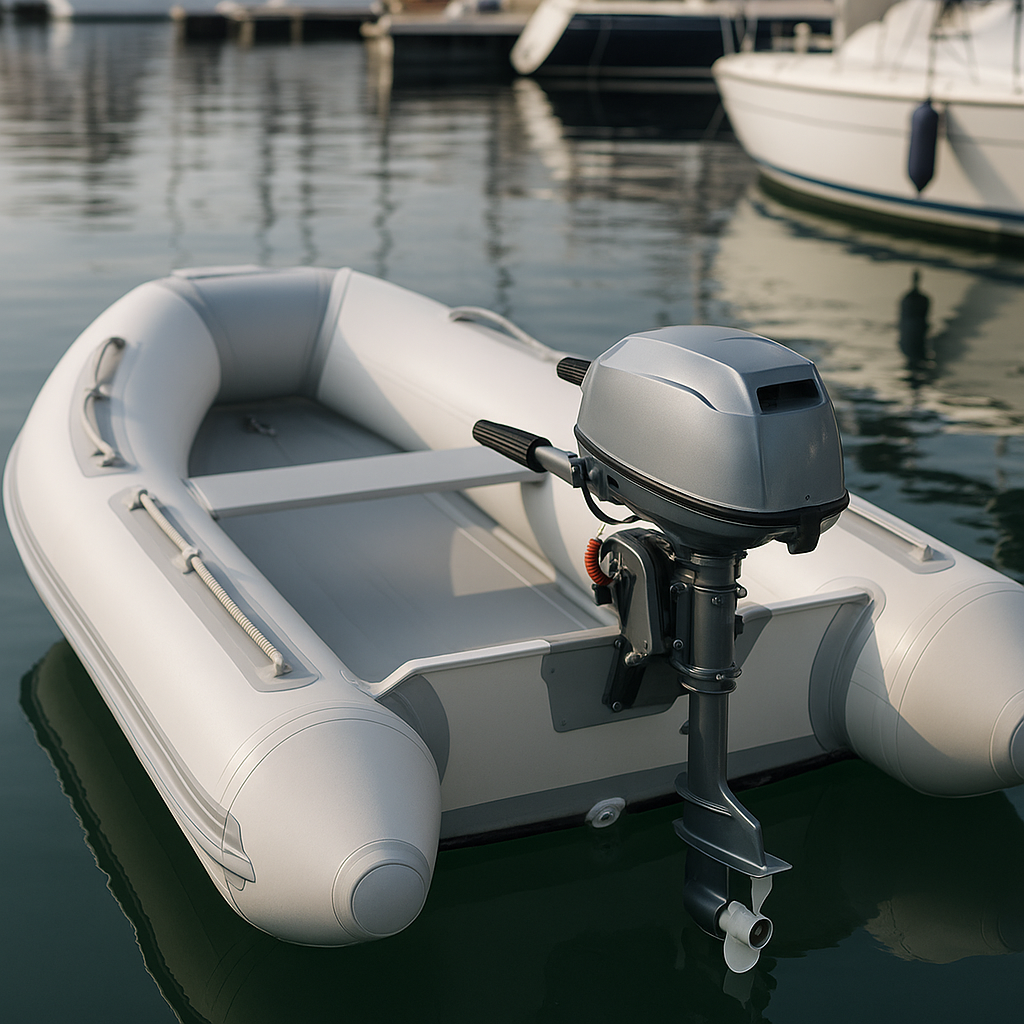
At 29 pounds, the BF2.3 is the go-to for inflatables and dinghy tenders. Honda's build quality at this power level is unmatched. The decompression system makes starting trivial, and the 0.26-gallon tank runs 90 minutes at cruise on most 8-foot tenders.
| Displacement | 57.2cc |
| Weight | 29 lb |
| Fuel | 4-stroke |

Tohatsu builds the power cells used in many Mercury and Nissan branded engines — here you get the same internals at a lower price. The MFS20 hits the sweet spot for 14–16 foot aluminum boats and rigid inflatables. Long shaft available. Excellent fuel economy at cruise.
| Displacement | 323cc |
| Weight | 99 lb |
| Fuel | 4-stroke |

Chinese-manufactured but with enough quality control improvements over the past three years to recommend. Hidea is the factory behind several rebrands. The 5hp is adequate for 10–12 foot aluminum hulls at light loads. Parts are available on Amazon. Not a primary engine for anyone who can afford a Yamaha.
| Displacement | 139cc |
| Weight | 54 lb |
| Fuel | 4-stroke |

The High Thrust variant runs a larger diameter, lower-pitch prop for trolling at low speeds without stalling. A must-have for walleye and muskie anglers who troll at 1–3 mph for extended periods. GPS-compatible throttle control available as an add-on.
| Displacement | 212cc |
| Weight | 88 lb |
| Thrust | High-thrust prop |
Four-Stroke vs Two-Stroke in 2026
Two-stroke portable outboards are nearly extinct in the US market outside of low-horsepower classes and specialty applications. Four-strokes dominate because they're quieter, cleaner, more fuel-efficient, and simpler to maintain. The weight penalty that once made two-strokes attractive in smaller sizes has largely closed — the Yamaha F9.9 is only 15 pounds heavier than its two-stroke equivalent was a decade ago.
Shaft Length: Short, Long, or Extra-Long

Measure from the top of the transom to 3 inches below the waterline at the stern. Short shaft is 15 inches and works for most small aluminum boats. Long shaft at 20 inches fits most inflatables, center consoles, and bass boats. Extra-long at 25 inches is for pontoon boats and larger hulls. Using the wrong shaft length causes ventilation, cavitation, or propeller damage — get this right before purchase.
Break-In Procedure
Every new four-stroke outboard requires a break-in period — typically 10 hours at varied RPM not exceeding 75% throttle, with an oil change at hour one and hour ten. Skipping break-in doesn't cause immediate failure but accelerates ring wear and reduces long-term performance. Follow the manufacturer procedure exactly — Yamaha's manual is more forgiving than Honda's for the first few hours.
Maintenance Reality
Annual service on a portable outboard takes 45 minutes: fresh lower-unit oil, check impeller (replace every 2–3 seasons), spark plugs every 100 hours, and fogging the cylinders for off-season storage. The impeller is the most commonly missed item — a failed impeller destroys the powerhead through overheating and typically costs $800–$2,000 to repair on an engine worth $1,500.