Best Trolling Motors for Kayaks and Small Boats (2026)

Alana Azzouz is a Senior Editor at Searchshop Media Network with over a decade of experience in consumer content quality and editorial standards. She has reviewed thousands of product guides, buying articles, and comp…
✎ Reviewed by Alana Azzouz — Senior Editor
Why trust us
TopBoatGear articles are researched by the Searchshop Editorial team using manufacturer specs, marine industry sources, and owner feedback. Our goal is simple: when a boater searches for gear, the recommendations they read online should match what a knowledgeable dealer or experienced owner would actually suggest. We may earn a commission on qualifying affiliate purchases; it doesn't influence what we recommend — if a product changes or a better option comes along, the article changes too.
How We Evaluated
We researched the top options, comparing them across key factors including performance, value, ease of use, and reliability. Our recommendations are based on editorial evaluation of verified specifications, owner-reported real-world performance, and domain expertise.
Why the Right Trolling Motor Matters

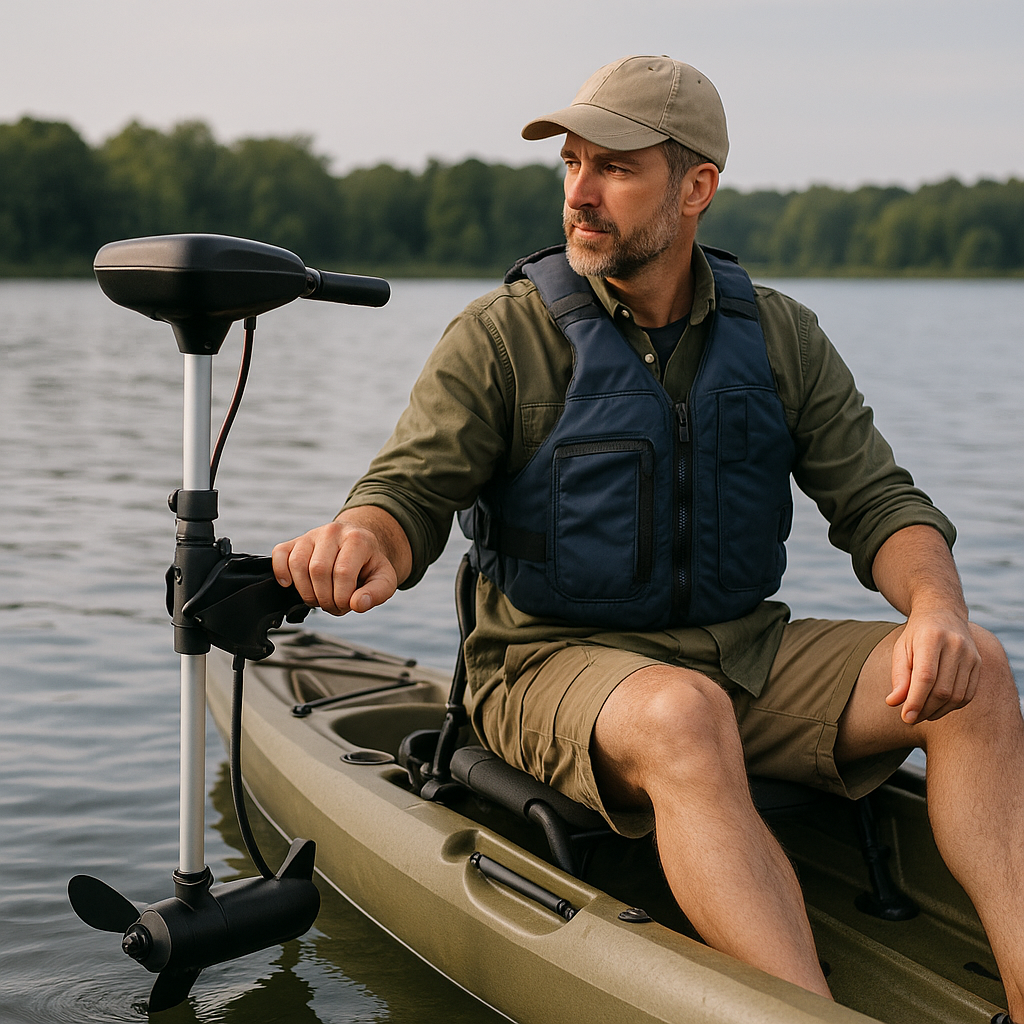
If you're shopping for the best trolling motor for kayak use, the wrong choice can make your setup awkward, underpowered, or frustratingly battery-hungry. We’ve found that kayaks and small boats need a different approach than full-size bass boats: lower weight, simpler mounting, efficient power draw, and better control at low speeds matter far more than raw thrust.
For this guide, we focused on compact motors that work well on fishing kayaks, jon boats, inflatables, and other small craft. Our top picks balance thrust, shaft length, durability, and ease of installation without overwhelming a lightweight hull.
Comparison Table
| Model | Thrust | Shaft Length | Voltage | Best For | Key Strength | Main Tradeoff |
|---|---|---|---|---|---|---|
| Minn Kota Endura C2 30 | 30 lb | 30 in | 12V | Most fishing kayaks | Reliable, simple, widely compatible | Basic speed control |
| Newport Vessels Kayak Series 36lb | 36 lb | 24 in | 12V | Dedicated kayak installs | Short shaft, kayak-friendly design | Less versatile on taller transoms |
| Minn Kota Endura Max 40 | 40 lb | 36 in | 12V | Long outings, battery savings | Maximizer tech improves runtime | Heavier and pricier |
| MotorGuide R3 45 | 45 lb | 36 in | 12V | Jon boats and heavier small craft | Strong thrust and sturdy mount | More motor than some kayaks need |
| Watersnake ASP T24 | 24 lb | 24 in | 12V | Tight budgets, ultralight boats | Lightweight and affordable | Limited power in wind/current |
Our Top Picks at a Glance

We recommend these motors for most kayak and small-boat buyers:
- Minn Kota Endura C2 30 – Best overall for most kayaks
- Newport Vessels Kayak Series 36lb – Best purpose-built kayak motor
- Minn Kota Endura Max 40 – Best for battery efficiency and longer trips
- MotorGuide R3 45 – Best for small boats needing more thrust
- Watersnake ASP T24 – Best budget pick for ultralight setups
How We Evaluated These Motors
We look at kayak and small-boat motors differently than we do larger transom-mounted systems. Here’s what mattered most in our testing and comparisons.
Thrust-to-Weight Balance
A 24- to 36-pound thrust motor is enough for many solo kayaks in calm to moderate conditions. Once you move into heavier fishing kayaks, tandem kayaks, jon boats, or windy lakes, 40 to 45 pounds becomes more useful. We don’t automatically recommend the highest thrust because more power often means more weight and faster battery drain.
Shaft Length
Shaft length is one of the most overlooked buying factors. Too long and the motor becomes awkward to stow, drags deeper than necessary, and can interfere with landing fish. Too short and the prop ventilates in chop. For kayaks, shorter shafts—often 24 to 30 inches—are usually easier to manage, while small boats often benefit from 30 to 36 inches.
Mounting Compatibility
Some motors are clearly better suited to side mounts or stern mounts on kayaks, while others fit a traditional transom better. We favored models that are easy to adapt to common kayak motor mounts without requiring extensive modification.
Battery Efficiency
On a kayak, every pound matters. That includes the battery. A motor that sips power can let you use a smaller lithium battery or get longer runtime from a standard deep-cycle battery. We gave extra points to motors with variable power management or proven efficiency.
Freshwater vs. Saltwater Use
If you fish brackish or saltwater environments, corrosion resistance becomes critical. While several freshwater motors can survive occasional saltwater use if cleaned immediately, dedicated saltwater models are the better long-term choice. Most anglers shopping this category still fish freshwater, so this guide leans that way.
Best Trolling Motors for Kayaks and Small Boats
1. Minn Kota Endura C2 30
The Minn Kota Endura C2 30 is our best overall pick because it hits the sweet spot for most anglers: enough thrust for a solo fishing kayak or light jon boat, a dependable mount, and a reputation for long-term reliability.
Why We Like It
At 30 pounds of thrust, this motor has enough push for common sit-on-top fishing kayaks, especially on lakes, ponds, and slow-moving rivers. The 30-inch shaft works well on many kayak stern mounts and smaller transoms without feeling oversized. We also like the telescoping tiller and the simple, proven control layout.
Minn Kota’s lever-lock bracket is sturdier than many budget clamps, which matters when a kayak mount flexes more than a rigid boat transom. In real use, that translates to less fiddling and more confidence when launching, beaching, or maneuvering around cover.
Pros
- Excellent reliability record
- Good thrust for most solo kayaks
- 30-inch shaft fits many small-craft setups well
- Easy-to-find parts and accessories
- Solid mount and straightforward controls
Cons
- No battery-maximizing digital control
- Not the lightest option in its class
- Freshwater-oriented design
Who It’s For
We recommend the Endura C2 30 for anglers who want a dependable, no-nonsense motor for a fishing kayak, canoe, or lightweight jon boat. It’s especially good for buyers who value reliability over extra features.
2. Newport Vessels Kayak Series 36lb
If you want a motor designed specifically with kayak use in mind, the Newport Vessels Kayak Series 36lb is one of the most practical options on the market.
Why We Like It
The standout feature here is the shorter 24-inch shaft. On many kayaks, that makes installation cleaner and handling easier than with standard small-boat trolling motors. You’re less likely to have excess shaft sticking up awkwardly behind the seat, and transport is easier too.
The 36-pound thrust rating gives it a little more authority than entry-level 30-pound motors, which helps if your kayak is fully rigged with electronics, crate, anchor, and tackle. We’ve found this extra margin is useful when working against light wind or current.
Pros
- Purpose-built for kayak mounting
- Short 24-inch shaft is easier to manage
- Strong thrust for a loaded fishing kayak
- Good balance of power and portability
- Simple setup for stern or side mounts
Cons
- Short shaft may be limiting on some small boats
- Not as widely supported as Minn Kota for parts
- Basic speed control compared with premium models
Who It’s For
This is the best fit for anglers building a dedicated motorized kayak setup and wanting a compact, kayak-friendly form factor rather than a downsized boat motor.
3. Minn Kota Endura Max 40
For anglers who make longer runs or spend full days on the water, the Minn Kota Endura Max 40 is our top battery-efficiency pick.
Why We Like It
The big advantage is Minn Kota’s Maximizer technology, which delivers variable power rather than fixed stepped speeds. In practical terms, that can significantly extend runtime at lower speeds—the exact range where kayak anglers spend most of their day.
With 40 pounds of thrust, this motor also handles heavier kayaks, tandem setups, and compact jon boats better than a 30-pound model. The 36-inch shaft is more versatile on small boats, though it can feel a little tall on some kayaks unless your mount position is dialed in.
Pros
- Better battery efficiency than fixed-speed motors
- Strong 40-pound thrust for heavier setups
- Smooth variable speed control
- Excellent option for long outings
- Trusted build quality
Cons
- More expensive than basic models
- Heavier than kayak-specific options
- 36-inch shaft can be longer than ideal for some kayaks
Who It’s For
We recommend the Endura Max 40 for anglers who prioritize runtime, use larger fishing kayaks, or want one motor that can serve both a kayak and a small jon boat.
4. MotorGuide R3 45
The MotorGuide R3 45 is the strongest motor on this list and a great choice when your “small boat” matters as much as your kayak.
Why We Like It
At 45 pounds of thrust, the R3 has enough power for heavier jon boats, utility skiffs, and fully loaded tandem craft. It’s a smart pick if you regularly fish in wind, carry a second angler, or need better control in current.
The composite shaft and rugged mount help it stand up to harder use. We especially like it for buyers who may be underestimating how much drag a loaded boat creates once gear, batteries, and electronics are onboard.
Pros
- Strong thrust for heavier craft
- Durable mount and shaft construction
- Good control in wind and current
- Works well on small jon boats
- Solid value for the power level
Cons
- Overkill for some solo kayaks
- Heavier and bulkier than compact options
- Higher battery draw at upper speeds
Who It’s For
Choose the R3 45 if you’re powering a heavier small boat, a tandem kayak, or a loaded fishing platform where extra thrust is more important than keeping weight to an absolute minimum.
5. Watersnake ASP T24
The Watersnake ASP T24 is our budget pick for anglers who want basic electric propulsion without spending heavily.
Why We Like It
This is a lightweight, simple motor that can work well on ultralight kayaks, canoes, inflatables, and small pond boats. It’s easy to transport, easy to store, and often costs substantially less than the major-brand alternatives.
That said, it’s best viewed as a calm-water solution. In sheltered ponds and small lakes, it does the job. In wind, current, or on heavier fishing kayaks, its lower thrust becomes more noticeable.
Pros
- Budget-friendly price
- Lightweight and easy to handle
- Good for small, calm-water craft
- Simple controls
- Compact for storage and transport
Cons
- Limited thrust in tougher conditions
- Less refined mount and materials
- Not ideal for heavily rigged kayaks
Who It’s For
We recommend the Watersnake ASP T24 for occasional users, pond anglers, and anyone building an ultralight setup on a strict budget.
Side-by-Side Verdict
If we had to choose one motor for the broadest range of buyers, the Minn Kota Endura C2 30 is still the safest overall recommendation. It’s dependable, appropriately sized for many kayaks, and easy to live with.
If your setup is truly kayak-first, the Newport Vessels Kayak Series 36lb is the more specialized choice. If battery efficiency matters most, the Minn Kota Endura Max 40 stands out. And if you need more muscle for a jon boat or heavier craft, the MotorGuide R3 45 is the clear winner.
What Size Trolling Motor Do You Need for a Kayak?
This is where many buyers either overspend or end up disappointed.
For Solo Kayaks
For most solo fishing kayaks under roughly 14 feet, 24 to 36 pounds of thrust is enough. If you fish mostly calm lakes and ponds, 24 to 30 pounds can work well. If your kayak is wide, heavily rigged, or used in windier conditions, 36 pounds is a safer target.
For Heavier Fishing Kayaks
Pedal-drive and fully rigged fishing kayaks are often heavier than buyers realize. Add a battery, fish finder, crate, rods, anchor, and tackle, and total load climbs quickly. In these cases, 36 to 40 pounds of thrust is often the sweet spot.
For Tandem Kayaks and Small Boats
If you’re running a tandem kayak, jon boat, or small utility craft, 40 to 45 pounds of thrust is usually more appropriate, especially if you expect current or wind.
Key Buying Factors Before You Order
Battery Type and Runtime
A trolling motor is only as useful as the battery behind it. We strongly recommend planning the battery and motor together.
- Lead-acid AGM/deep-cycle batteries cost less upfront but add significant weight.
- Lithium LiFePO4 batteries cost more but save a lot of weight and usually offer better usable capacity.
For kayaks, lithium often makes more sense if your budget allows it. Saving 20 to 40 pounds in battery weight can dramatically improve handling and transport.
Mounting Style
Before buying, confirm whether your kayak uses:
- Stern mount
- Side mount
- Bow mount adapter
- Custom track-mounted bracket
A great motor can still be a poor choice if it doesn’t fit your mounting plan cleanly.
Shaft Length Fit
Measure from the motor mount location to the waterline when the kayak is loaded. That number tells you far more than guessing from product photos. In general, we want the prop deep enough to stay submerged in chop but not so deep that the motor becomes clumsy.
Freshwater or Saltwater Use
If you fish saltwater regularly, don’t treat that as a minor detail. Corrosion resistance, sealed electrical components, and sacrificial-anode-friendly designs matter. For occasional inshore use, immediate rinsing helps, but a true saltwater motor is still the better long-term investment.
Weight and Portability
A motor that performs well on the water still has to get from your garage to the launch. We always remind kayak anglers to think beyond thrust:
- Can you carry the motor and battery separately?
- Will the shaft fit in your vehicle?
- Is the mount easy to remove for cartopping?
These practical issues shape satisfaction more than spec-sheet differences.
Common Mistakes We See Buyers Make
Buying Too Much Motor
More thrust sounds better until you’re lifting a heavier motor, carrying a larger battery, and dealing with a bulkier shaft on a narrow kayak. For many anglers, a 30- or 36-pound motor is the smarter match.
Ignoring Battery Weight
A lightweight kayak can become surprisingly awkward once you add a 50- to 60-pound lead-acid battery. If portability matters, budget for the battery solution from day one.
Choosing the Wrong Shaft Length
This is one of the easiest ways to ruin an otherwise good setup. Always match the shaft to your loaded waterline and mount height.
Overlooking Local Rules
Some waters require registration once you add a motor, even to a kayak. Others have horsepower or electric-only restrictions. Check before you buy.
Our Recommendation by Use Case
Best Overall
Minn Kota Endura C2 30 – Best mix of reliability, price, and practical performance.
Best for Dedicated Kayak Setups
Newport Vessels Kayak Series 36lb – Best shaft length and form factor for many kayak builds.
Best for Long Runtime
Minn Kota Endura Max 40 – Best efficiency and control for all-day anglers.
Best for Small Boats and Heavier Loads
MotorGuide R3 45 – Best thrust when conditions or payload demand more power.
Best Budget Pick
Watersnake ASP T24 – Best low-cost option for calm water and lighter craft.
Final Verdict
For most anglers, the best trolling motor for kayak use is the Minn Kota Endura C2 30. It has enough thrust for the majority of solo fishing kayaks, a manageable shaft length, dependable construction, and broad compatibility with common mounts.
If you want a more kayak-specific solution, we’d step up to the Newport Vessels Kayak Series 36lb. And if your priorities are longer runtime or heavier craft, the Endura Max 40 and MotorGuide R3 45 are better fits.
The key is to match the motor to your actual hull, load, water conditions, and battery plan—not just buy the biggest model you can afford.
FAQ
What thrust trolling motor is best for a kayak?
For most solo fishing kayaks, we recommend 30 to 36 pounds of thrust. Lighter kayaks in calm water can use 24 pounds, while heavier or tandem setups often need 40 pounds or more.
Is a 30 lb thrust trolling motor enough for a kayak?
Yes, for many solo kayaks it is. A 30 lb motor is usually enough for lakes, ponds, and slow-moving water, especially if the kayak is not heavily loaded.
What shaft length is best for a kayak trolling motor?
For many kayaks, 24 to 30 inches works best. The right length depends on your mount height and loaded waterline, so measuring your setup is more reliable than guessing.
Can I use a freshwater trolling motor in saltwater?
You can for occasional use, but we don’t recommend it as a long-term solution. Saltwater exposure accelerates corrosion, so a saltwater-rated motor is the better choice if you fish coastal or brackish water regularly.
What battery should I use with a kayak trolling motor?
A 12V deep-cycle battery is standard. We prefer LiFePO4 lithium batteries for kayaks because they provide strong runtime at much lower weight than traditional lead-acid batteries.
Get your free Get Our Free Boat Gear Checklist
The essential marine gear list every boater should have before hitting the water.