
The Marine VHF Radio Buying Guide: Fixed-Mount, Handheld, and DSC Explained
 By Lance Greiner — General Manager, Boater's World · Former Platform GM, Travelcamp RV· September 21, 2025· 1 min read· Updated Oct 18, 2025
Lance Greiner is a career marine and automotive retail professional with more than 15 years of dealership management experience. He currently serves as General Manager at Boater's World in Florida, overseeing full mar…
Why trust us
Every article on TopBoatGear is independently researched by the Searchshop Editorial team using manufacturer documentation, independent marine industry sources, and verified owner reviews from boaters across the US. We earn a small commission on qualifying purchases through affiliate links, which never influences our recommendations.

Cell phones are not safety equipment. A cell phone in a man-overboard situation, in a fire, or in a sinking is a private call to one party who may or may not answer and who almost certainly cannot help in time. A VHF radio is a public broadcast on a frequency that the Coast Guard, every commercial vessel within 25 miles, and every recreational boater within line of sight is required to monitor.
If you take one piece of advice from this site, take this: buy a proper fixed-mount DSC VHF, register your MMSI number, connect it to your GPS, and learn to use Channel 16. Here is how to choose the right one.
Top Picks by Use Case

Built-in 66-channel GPS, integrated AIS receiver, dual-receive on Channel 16, and a separate noise-canceling microphone for foul weather. The GX2400 is the gold standard for blue-water boats. Standard Horizon's three-year warranty is the longest in the category.
| Power | 25W fixed |
| GPS | Internal 66-ch |
| AIS | Receive |

If you boat in protected water and just need a reliable DSC radio, the M330 is the answer. Compact, NMEA 0183 ready, white or black faceplate, and Icom's bulletproof construction.
| Power | 25W |
| GPS | External required |
| Form factor | Compact |
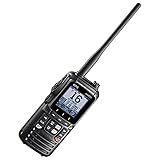
Floats, flashes a strobe when wet, has DSC and integrated GPS, and Standard Horizon's noise-canceling speaker is genuinely the best in the category. The handheld every offshore boat should have in the ditch bag.
| Power | 6W |
| GPS | Internal |
| Floats | Yes + strobe |
Fixed-Mount vs Handheld
A fixed-mount VHF transmits at 25 watts and reaches 20–25 miles at sea with a proper antenna. A handheld transmits at 5–6 watts and reaches 5–8 miles. The fixed unit is your primary radio; the handheld is a backup that lives on your person, in a ditch bag, or in the dinghy.
Every boat that ventures more than a mile from shore needs both. The fixed unit gives you range; the handheld gives you a radio that still works when you're in the water and the boat is not.
What DSC Actually Does

Digital Selective Calling (DSC) is the killer feature that turns a VHF from a chat radio into a safety tool. Press the red distress button, and the radio transmits a digital burst on Channel 70 containing your MMSI number (your boat's unique digital identity), the nature of the emergency, and — critically — your GPS coordinates. The Coast Guard and every DSC-equipped vessel within range receives an alarm and knows exactly where you are.
DSC only works if you do two things: connect your VHF to a GPS source (most fixed units have built-in GPS now), and register an MMSI number. In the US, register through BoatUS or Sea Tow for free if you stay in US waters, or directly through the FCC (paid) if you cruise internationally.
AIS: Listen Only vs Transmit
Automatic Identification System (AIS) is the technology that lets commercial vessels broadcast their identity, position, course, and speed. Many modern VHF units include an AIS receiver — listen-only — that overlays nearby commercial traffic on your chartplotter. This is genuinely useful in fog and at night.
An AIS transponder (Class B) broadcasts your own boat to the same network and costs $700–1,200 as a standalone unit. If you cross shipping lanes, run inlets at night, or fish offshore, a Class B transponder is the single best safety upgrade you can make.
Antenna and Cable
A $400 radio with a $30 antenna and corroded coax will outperform a $1,200 radio with a $200 antenna and corroded coax. Spend on the antenna and the cable run, and inspect both annually. An 8-foot, 6 dB gain antenna is the standard for sailboats and small powerboats; 4 dB and lower for big-water boats that roll, 9 dB for stable platforms that don't.
Installation Notes
Mount the antenna as high as practical — VHF is line-of-sight, and every foot of antenna height adds meaningful range. Use proper marine-grade coax (RG-8X for runs under 20 feet, RG-213 for longer). Seal every connection with marine-grade heat-shrink. Ground the radio to a common bonding point. Then test, on Channel 9, with a friend on another boat or with a marina you trust.
Top Picks & Comparison
| # | Product | Price | Rating | ||
|---|---|---|---|---|---|
| #1 | S |
Standard Horizon GX2400 Matrix AIS+ |
$549 | — | View on Amazon |
| #2 | |
Icom M330 |
$199 | — | View on Amazon |
| #3 | |
Standard Horizon HX890 |
$249 | — | View on Amazon |