Best Boat Fenders to Protect Your Hull at the Dock (2026)

Alana Azzouz is a Senior Editor at Searchshop Media Network with over a decade of experience in consumer content quality and editorial standards. She has reviewed thousands of product guides, buying articles, and comp…
✎ Reviewed by Alana Azzouz — Senior Editor
Why trust us
TopBoatGear articles are researched by the Searchshop Editorial team using manufacturer specs, marine industry sources, and owner feedback. Our goal is simple: when a boater searches for gear, the recommendations they read online should match what a knowledgeable dealer or experienced owner would actually suggest. We may earn a commission on qualifying affiliate purchases; it doesn't influence what we recommend — if a product changes or a better option comes along, the article changes too.
How We Evaluated
We researched the top options, comparing them across key factors including performance, value, ease of use, and reliability. Our recommendations are based on editorial evaluation of verified specifications, owner-reported real-world performance, and domain expertise.
If you are shopping for the best boat fenders for docking, the right choice comes down to more than just size. Shape, material, valve quality, line attachment points, and how well a fender stays in place against pilings or rough dock faces all matter when you are trying to protect your hull. We researched leading options across calm marinas, tidal docks, and tighter slips to find the picks that deliver the best mix of protection, durability, and value.
Side-by-Side Comparison and Verdict

Choosing between these fenders gets easier when you match the design to your docking style rather than buying the biggest model you can find.
Feature Comparison
| Product | Durability | Storage Ease | Best in Tight Slips | Best for Large Boats | Value |
|---|---|---|---|---|---|
| Polyform G Series | High | Medium | Medium | Medium | High |
| Taylor Made Big B | Medium-High | Medium | Medium | Low-Medium | High |
| Polyform F Series | High | Low-Medium | Medium | High | Medium |
| Mission Sentry | High | High | High | Medium | Medium |
| Dock Edge Twin Eye | Medium | Medium | Medium | Low | High |
| Polyform HTM Series | Very High | Low | Low-Medium | Very High | Medium |
Clear Verdict
If we had to recommend one option to the widest range of boat owners, we would choose the Polyform G Series. It offers the most consistent all-around docking protection and long-term durability for typical recreational boats.
If value is your top priority, go with the Taylor Made Big B. If you dock a larger, heavier boat, the Polyform F Series or HTM Series is the better fit. And if your slip is tight and standard fenders tend to shift, the Mission Sentry is the smartest specialty pick.
Our Top Picks at a Glance
Boat fenders are simple in concept, but the differences between a cheap fender and a dependable one show up fast after a season of sun, scuffs, and repeated impacts. We focused on durability, ease of inflation, resistance to marking, and how each fender performed in realistic docking scenarios.
Comparison Table
| Product | Type | Best For | Key Strength | Main Drawback | Best Boat Size |
|---|---|---|---|---|---|
| Polyform G Series | Round utility fender | Overall docking protection | Tough vinyl and proven durability | Bulkier than slim profiles | 20-40 ft |
| Taylor Made Big B Inflatable | Traditional cylindrical fender | Value and all-around use | Good protection for the price | Not as heavy-duty as premium models | 18-35 ft |
| Polyform F Series | Twin-eye cylindrical fender | Larger boats and rough docks | Thick walls and strong eyelets | More expensive and heavier | 25-50 ft |
| Mission Sentry Boat Fender | Flat profile fender | Tight slips and low freeboard boats | Stays put and saves space | Costs more than standard inflatables | 20-35 ft |
| Dock Edge Twin Eye PVC Fender | Cylindrical fender | Budget buyers | Affordable and easy to rig | Shorter lifespan under hard use | 16-30 ft |
| Polyform HTM Series | Center-hole mooring fender | Big boats and rafting | Maximum cushioning and size options | Overkill for smaller boats | 30-60 ft |
Best Boat Fenders to Protect Your Hull at the Dock

1. Polyform G Series
The Polyform G Series is our top overall pick because it strikes the best balance between durability, impact absorption, and long-term value. We have used G Series fenders on center consoles, cruisers, and small sportfish boats, and they consistently hold up to dock boards, pilings, and uneven marina faces.
The molded vinyl feels thicker than many budget alternatives, and the reinforced ropehold is less likely to crack after repeated loading. These fenders also resist abrasion well, which matters if your slip has rough wood or barnacle-prone pilings.
Pros
- Thick, durable vinyl construction
- Reliable cushioning for most docking conditions
- Wide size range for different boat lengths
- Proven long-term performance
Cons
- Takes up more storage room than flat fenders
- Can roll slightly if not tied at the right height
Who It's For Boat owners who want a dependable, do-everything fender for regular docking, rafting, or transient marina stops.
2. Taylor Made Big B Inflatable
If you want solid performance without paying premium prices, the Taylor Made Big B is one of the easiest recommendations we can make. It is widely available, simple to inflate, and offers enough cushioning for typical weekend boating.
During testing, we found the Big B handled standard marina contact well, especially on fiberglass runabouts and mid-size bowriders. The color options are also a plus if you care about matching your topsides or canvas.
Pros
- Strong value for the money
- Easy to find in multiple sizes and colors
- Good protection for normal docking use
- Lightweight and easy to handle
Cons
- Not the best choice for heavy commercial-style use
- Vinyl is not as thick as top-tier premium picks
Who It's For Owners of small to mid-size boats who need reliable everyday fenders at a reasonable price.
3. Polyform F Series
The Polyform F Series is a step up for larger boats or harsher docking environments. Its twin-eye cylindrical design gives you flexible rigging options, and the thicker wall construction inspires confidence when docking in current, wind, or against rough pilings.
We especially like the F Series for express cruisers and heavier center consoles that carry more momentum into the dock. The added material helps absorb harder bumps without feeling overly rigid.
Pros
- Excellent wall thickness and impact absorption
- Strong eyelets for vertical or horizontal rigging
- Better suited to larger, heavier boats
- Durable enough for frequent use
Cons
- Higher price than entry-level fenders
- Heavier and bulkier to move around
Who It's For Owners of larger recreational boats who dock often in challenging conditions and want more protection than standard budget fenders provide.
4. Mission Sentry Boat Fender
Not every docking setup works well with traditional round fenders. In tight slips, especially where clearance is limited, a flat-profile option like the Mission Sentry can make life much easier. We researched it on pontoons, wake boats, and low-freeboard boats where conventional fenders tended to roll out of place.
Its shape helps it stay where you put it, and it stores more easily than oversized round fenders. That makes it a smart premium choice for modern boats with limited storage compartments.
Pros
- Flat design resists rolling out of position
- Great for tight slips and close dock spacing
- Easier to store than bulky round fenders
- Clean, modern design
Cons
- More expensive than traditional inflatable fenders
- Less versatile for some rafting scenarios
Who It's For Boaters with tight docking spaces, wake boats, pontoons, or boats where storage space is limited and fender stability matters.
5. Dock Edge Twin Eye PVC Fender
For occasional boaters or anyone outfitting a smaller boat on a tight budget, the Dock Edge Twin Eye PVC Fender is a practical starting point. It does not feel as robust as premium Polyform models, but it can still provide worthwhile protection in calm marina conditions.
We see this as a good spare-fender option too. Keeping one or two extras aboard is never a bad idea, especially if you end up docking on an unfamiliar side.
Pros
- Budget-friendly price
- Twin-eye design allows flexible rigging
- Fine for lighter-duty use
- Good as a backup or spare
Cons
- Durability is lower than premium picks
- Not ideal for rough docks or heavier boats
Who It's For Casual boaters, first-time owners, and anyone who needs a low-cost spare or starter set.
6. Polyform HTM Series
If you run a larger cruiser, yacht, or heavily loaded offshore boat, the Polyform HTM Series is the heavy hitter of this group. These center-hole fenders are built for serious cushioning and are often seen on larger vessels that need more displacement and contact area.
When we compared them against standard cylindrical fenders on heavier boats, the HTM models provided better stand-off distance from rough pilings and floating docks. They are not compact, but that is the tradeoff for serious protection.
Pros
- Outstanding cushioning for large boats
- Durable construction for demanding use
- Excellent for rafting and rough docking areas
- Broad size range for bigger hulls
Cons
- Large and awkward to store
- More fender than most small boats need
Who It's For Owners of bigger cruisers, yachts, and boats that need maximum hull protection at the dock.
How to Choose the Right Boat Fender
The best fender is not always the most expensive one. It is the one that matches your boat’s size, freeboard, hull shape, and docking conditions.
1. Match Fender Size to Boat Length
As a general rule, larger boats need larger diameter fenders because they carry more weight and momentum. Small fenders on a heavy boat compress too easily and leave your hull vulnerable.
A simple guideline:
- 15-20 ft boats: smaller utility or cylindrical fenders
- 20-30 ft boats: mid-size cylindrical or round fenders
- 30-40 ft boats: larger cylindrical or heavy-duty round fenders
- 40 ft and up: oversized cylindrical, center-hole, or specialty heavy-duty fenders
2. Consider Your Dock Type
Ask where and how you dock most often.
- Floating docks: Standard cylindrical fenders usually work well
- Fixed docks with tidal change: You may need multiple heights or larger fenders
- Pilings: Round or larger-profile fenders often protect better
- Tight slips: Flat-profile fenders can stay in place better
3. Look at Hull Shape and Freeboard
Low-profile boats, pontoons, and wake boats often benefit from flatter fender shapes. Higher-freeboard cruisers generally do well with traditional cylindrical fenders hung at the right height.
4. Check Material and Valve Quality
Cheaper fenders often fail at the valve or eyelet first. We recommend looking for marine-grade vinyl, reinforced ends, and dependable inflation hardware.
5. Buy Enough Fenders
Many owners underbuy. We recommend carrying at least three to four quality fenders for small to mid-size boats, and more for larger boats or variable docking situations.
How to Rig Boat Fenders Correctly
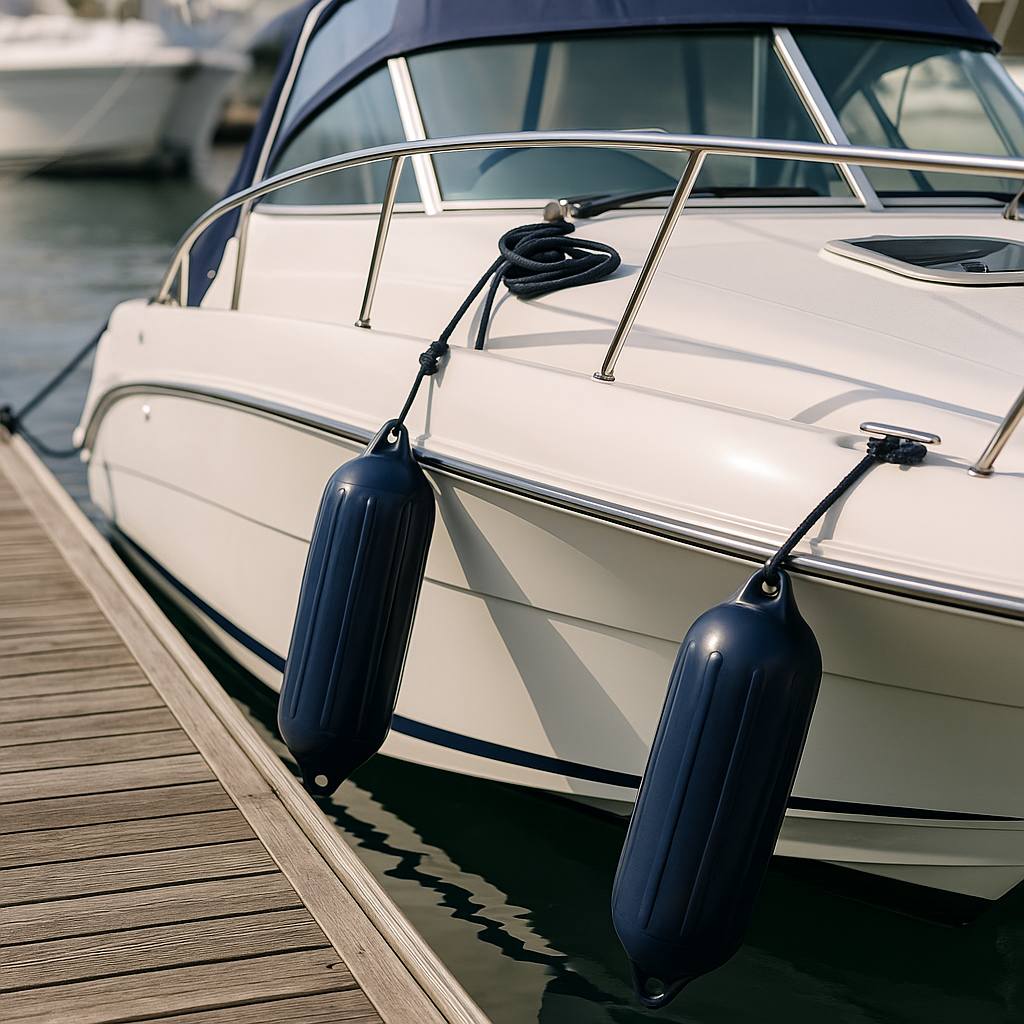
Even the best boat fenders for docking will not help much if they are hung too high, too low, or too far apart. Proper setup matters as much as product choice.
Materials and Tools
Before rigging, gather:
- Boat fenders
- Fender lines sized for the fender eyes
- Cleats, rails, or dedicated fender adjusters
- Air pump with the proper inflation tip if adjustment is needed
- Optional chafe guards or fender covers
Numbered Steps
- Identify contact points. Look at where your hull is most likely to touch the dock, pilings, or neighboring boat.
- Place the first fender at the widest beam. This is usually the most important protection point.
- Add bow and stern fenders. Space them to protect the front and rear thirds of the hull.
- Adjust height carefully. The fender should sit where contact actually happens, not just where it looks balanced.
- Tie secure knots. Use cleat hitches or other reliable knots that can be adjusted quickly.
- Test before final docking. As you ease in, watch whether the fenders stay in place and carry the load.
- Reposition for changing conditions. Tides, passenger load, and fuel level can change hull height at the dock.
Safety Tips
- Never put hands or feet between the boat and dock while adjusting fenders underway
- Set fenders before entering a slip whenever possible
- Keep spare lines aboard in case one chafes or snaps
- Avoid overinflating, which can reduce cushioning and stress seams
- Replace cracked, hardened, or badly scuffed fenders before they fail
Common Fender Mistakes We See
A lot of hull damage comes from setup errors rather than bad products.
Using Fenders That Are Too Small
Undersized fenders flatten too easily and can leave the hull contacting the dock directly.
Hanging Them Too High
A fender that sits above the actual rub point is almost useless. We always recommend checking height from the dock side, not just from onboard.
Relying on Only Two Fenders
Two may be enough for a quick tie-up in calm conditions, but they often leave gaps along the hull. Extra coverage is cheap insurance.
Ignoring Dock Conditions
Rough timber, pilings, and tidal movement all call for more robust fender setups than smooth floating docks.
Are Fender Covers Worth It?
In many cases, yes. Fender covers can reduce squeaking, minimize scuff transfer, and help protect gelcoat from grime embedded in bare vinyl. We like them most for darker-colored hulls and boats that stay in the slip for long periods.
That said, covers also need cleaning. A dirty cover can become abrasive over time, so they are not maintenance-free.
Our Final Recommendation
After comparing shape, durability, real-world docking performance, and value, we recommend the Polyform G Series as the best overall choice for most recreational boat owners. It is dependable, widely available, and tough enough for repeated marina use without jumping into oversized, hard-to-store territory.
If you need a budget-friendly option, the Taylor Made Big B is our value pick. For larger boats and rougher docking environments, we would step up to the Polyform F Series or HTM Series. And for tight slips where traditional fenders tend to roll or shift, the Mission Sentry stands out as the most practical premium alternative.
The right fender setup can save you far more than it costs. A few well-chosen fenders, rigged properly, are one of the smartest upgrades you can make for stress-free docking and long-term hull protection.
FAQ
What size boat fenders do I need for docking?
It depends on your boat length, weight, and docking conditions. As a starting point, small boats can use smaller cylindrical fenders, while cruisers and larger boats need thicker, larger-diameter models that provide more stand-off distance.
How many fenders should I keep on my boat?
We recommend at least three to four for most small to mid-size recreational boats. Larger boats, or boats that dock in changing conditions, should carry more.
Are round or cylindrical fenders better?
Cylindrical fenders are usually better for general docking along flat docks. Round fenders can be excellent around pilings, rough structures, or situations where you want more localized cushioning.
Can I leave boat fenders outside all season?
Yes, but UV exposure and abrasion will shorten lifespan over time. We recommend rinsing them periodically, checking inflation, and replacing any fender that shows cracking or hardening.
Should boat fenders be hard or soft when inflated?
They should be firm enough to hold shape but not rock hard. Slight give is important because that is what helps absorb impact instead of transferring it straight to the hull.
Get your free Get Our Free Boat Gear Checklist
The essential marine gear list every boater should have before hitting the water.