
The Best Winches for Trailer, Sailing, and Anchoring Applications
 By Lance Greiner — General Manager, Boater's World · Former Platform GM, Travelcamp RV· June 12, 2026· 1 min read
Lance Greiner is a career marine and automotive retail professional with more than 15 years of dealership management experience. He currently serves as General Manager at Boater's World in Florida, overseeing full mar…
Why trust us
Every article on TopBoatGear is independently researched by the Searchshop Editorial team using manufacturer documentation, independent marine industry sources, and verified owner reviews from boaters across the US. We earn a small commission on qualifying purchases through affiliate links, which never influences our recommendations.
The Rankings


A two-speed trailer winch with a proper ratchet mechanism is the minimum acceptable equipment for loading any boat over 1,000 pounds onto a trailer. The Fulton F2's two-speed planetary gear reduces loading effort by 70% on the high-ratio gear, and the ratchet hold prevents the bow eye from slipping back during positioning. More reliable than cheap single-speed winches that strip gears under hull weight.
| Capacity | 2,000 lb |
| Speed | 2-speed |
| Strap | 20-foot included |

Loading a boat alone is substantially safer with an electric trailer winch — the wireless remote lets one person position the boat on the trailer with one hand on the remote and one on the bow. The T10004 handles boats up to 16–18 feet reliably; for larger boats the stress on the bow eye and trailer frame exceeds safe limits.
| Capacity | 1,500 lb |
| Control | Remote wired or wireless |
| Voltage | 12V DC |

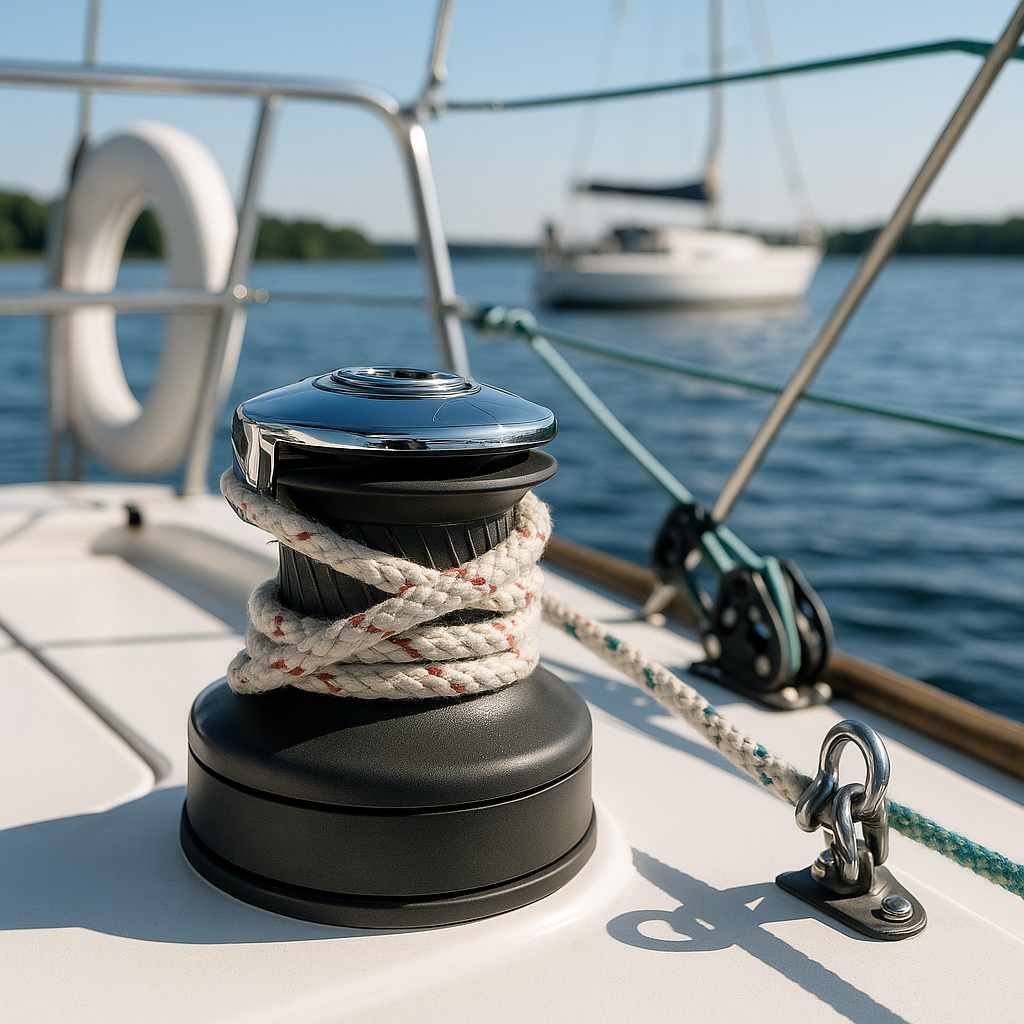
Harken winches are the sailboat rigging gold standard. The self-tailing jaw grip eliminates the need for a dedicated crew member to tail the sheet while another grinds — critical for shorthanded sailing. The 40 is appropriately sized for sheets on 30–42 foot sailboats. Chrome drum, anodized aluminum base, and Delrin pawls that stay functional in saltwater without constant greasing.
| Size | 40 (sheet size up to 9/16") |
| Speed | 2-speed |
| Material | Anodized aluminum |

Lewmar's CST series provides self-tailing convenience at a price accessible for smaller sailboats and budget refits. The 16CST is correctly sized for sheets on 24–32 foot sailboats in moderate conditions. Single-speed requires more turns than a two-speed but is completely adequate for casual coastal sailing. Chrome drum resists salt fog better than painted aluminum.
| Size | 16 (sheet size up to 7/16") |
| Speed | 1-speed |
| Use case | Smaller sailboats |

Anchor windlasses transform the anchoring experience on any boat over 28 feet — what was 10 minutes of back-breaking work becomes 90 seconds of controlled deployment and retrieval from the helm. The Cayman 700W is the price-quality sweet spot for boats up to 38 feet with rode up to 200 feet. Horizontal windlass design integrates better with existing bow roller and cleat positioning than vertical units.
| Power | 700W / 12V |
| Pull | 1,500 lb |
| Compatible chain | 1/4" G4 and 5/16" G7 |
Winch Sizing: How to Match Winch to Application
Trailer winches: rate by boat-plus-gear weight, not just hull weight. A 19-foot boat with motor, fuel, and gear frequently weighs 3,000 pounds. Size the winch at 1.5x the combined weight to allow headroom. Sailing winches: use the manufacturer's sheet load table, which accounts for sail area and boat length. Anchor windlass: minimum 1.5x the combined weight of all ground tackle (anchor + chain + rope) that the windlass must lift. Undersizing a windlass is the single most common installation mistake.
Manual vs Electric: When to Upgrade

Trailer winches: manual is adequate up to 1,500 lb or for 2-person loading situations. Electric is worth the investment for solo launching and loading, especially with a boat over 16 feet. Sailing winches: two-speed manual handles most racing and coastal cruising situations competently. Electric is valuable for offshore passages where crew fatigue accumulates over long tacks. Anchor windlass: manual anchoring beyond 25 pounds of ground tackle (anchor + chain) is genuinely hard work that most owners avoid — leading to inadequate anchoring. Any cruising boat with 25+ pounds of ground tackle should have electric windlass.
Stainless vs Chrome vs Anodized Aluminum Drums
Chrome-plated steel drums are the most durable option for sheet winches but expensive to manufacture. Anodized aluminum is lighter and corrosion-resistant but the anodizing layer wears through in high-use areas within 5–7 years, exposing base aluminum that corrodes. Stainless steel drums are the right choice for low-maintenance applications. Painted aluminum is never appropriate for a saltwater winch — it chips, rusts through, and stains sails and dock lines. Inspect drum surfaces annually and replace worn chrome drums before the bare steel beneath begins to rust.
Winch Maintenance Schedule
Sheet winches: flush with fresh water after every offshore passage, wash with mild soap annually, disassemble and relubricate with Lewmar or Harken winch grease every 2–3 seasons (more often in tropical saltwater use). Trailer winches: inspect strap or cable for fraying or kinking before every launch, lubricate ratchet pawls quarterly, replace strap every 3 years regardless of appearance. Anchor windlass: rinse gypsy and chain pipe after every use, lubricate per manufacturer schedule, inspect clutch mechanism annually.