Best Dock Lines and Mooring Rope for Every Boat Size (2026)

Alana Azzouz is a Senior Editor at Searchshop Media Network with over a decade of experience in consumer content quality and editorial standards. She has reviewed thousands of product guides, buying articles, and comp…
✎ Reviewed by Alana Azzouz — Senior Editor
Why trust us
TopBoatGear articles are researched by the Searchshop Editorial team using manufacturer specs, marine industry sources, and owner feedback. Our goal is simple: when a boater searches for gear, the recommendations they read online should match what a knowledgeable dealer or experienced owner would actually suggest. We may earn a commission on qualifying affiliate purchases; it doesn't influence what we recommend — if a product changes or a better option comes along, the article changes too.
How We Evaluated
We researched the top options, comparing them across key factors including performance, value, ease of use, and reliability. Our recommendations are based on editorial evaluation of verified specifications, owner-reported real-world performance, and domain expertise.
Best Dock Lines and Mooring Rope for Every Boat Size
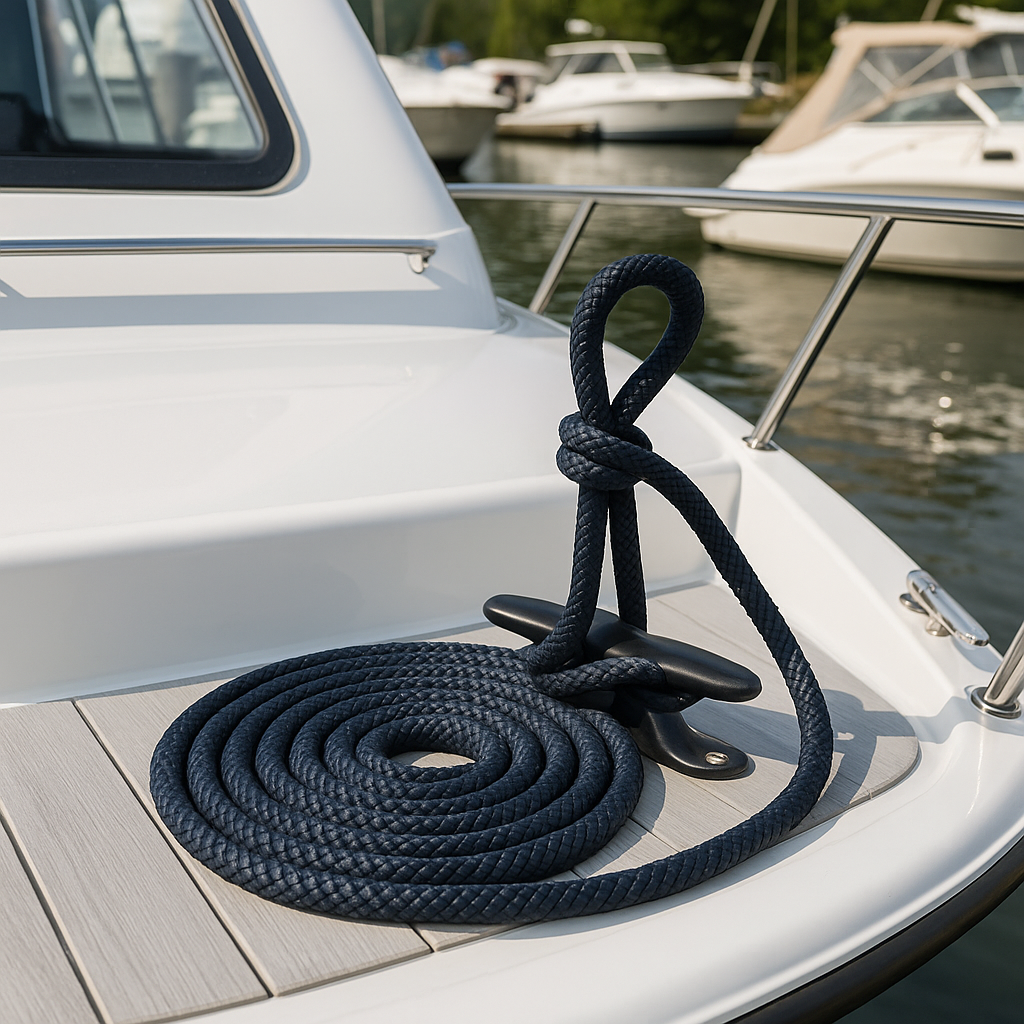
Choosing the best dock lines for boats is one of the simplest ways we can protect our hull, cleats, and peace of mind at the dock. The right mooring rope absorbs shock, resists chafe, and matches our boat’s size and local conditions. The wrong line can snap, stretch too much, or wear through when wind, current, and wake pick up.
In this TopBoatGear buyer’s guide, we’ll compare dock line materials, explain what size and length to buy, and show how to match mooring rope to everything from small fishing boats to larger cruisers and sailboats.
Comparison Table: Best Dock Lines for Boats by Size and Use

| Boat Size | Recommended Diameter | Typical Line Lengths | Best Material | Best For | Notes |
|---|---|---|---|---|---|
| Up to 20 ft | 3/8 in | 15-20 ft | Double-braided nylon | Small runabouts, skiffs, PWCs on docks | Easy to handle, enough stretch for light boats |
| 20-30 ft | 1/2 in | 20-25 ft | Double-braided nylon | Center consoles, bowriders, small sailboats | Great all-around size for most weekend boaters |
| 30-40 ft | 5/8 in | 25-30 ft | Double-braided nylon or 3-strand nylon | Cruisers, larger sailboats | More shock absorption and cleat security |
| 40-50 ft | 3/4 in | 30-35 ft | Premium nylon with chafe guards | Larger express boats and motoryachts | Prioritize abrasion resistance and splice quality |
| 50+ ft | 7/8 in to 1 in | 35-50 ft | Heavy-duty nylon mooring lines | Big yachts, exposed docks, strong tide/current | Consider custom lengths and backup lines |
| Mooring ball use | Size up one step if exposed | Varies by setup | 3-strand or double-braid nylon | Permanent or semi-permanent mooring | Use thimbles, pendants, and serious chafe protection |
Why Dock Lines Matter More Than Most Boaters Think
Dock lines do much more than simply tie a boat to a cleat. They help control movement in three directions:
- Forward and aft motion with bow and stern lines
- Side-to-side movement with spring lines and proper spacing
- Vertical shock loads caused by wake, tides, and surge
A quality dock line acts like part of our docking system, along with fenders, cleats, chocks, and pilings. If one part is undersized or poorly matched, the whole setup becomes less secure.
When we shop for dock lines, we’re really buying for five things:
- Strength
- Stretch and shock absorption
- UV and abrasion resistance
- Ease of handling
- Correct length and diameter for our boat
Dock Line vs Mooring Rope: Is There a Difference?

Boaters often use the terms interchangeably, but there is a practical distinction.
- Dock lines usually refer to the ropes we use for routine docking at slips, marinas, and alongside fixed docks.
- Mooring rope can refer to heavier-duty lines used on mooring balls, exposed docks, tidal areas, or more permanent tie-ups.
In practice, the best products can often serve both roles if they’re sized correctly. For everyday marina use, we usually want flexible, easy-handling dock lines with moderate stretch. For exposed moorings, we may need beefier rope, stronger chafe protection, and more redundancy.
The Best Rope Materials for Dock Lines
Not all rope behaves the same way. Material matters as much as diameter.
Nylon: Best Overall for Most Boats
If we had to recommend one material for most recreational boaters, it would be nylon.
Why nylon works so well:
- Excellent shock absorption
- Good strength for its size
- Handles repeated loading well
- Common and widely available
- Suitable for both dock lines and mooring applications
Nylon stretches under load, which is exactly what we want when wind or wake jerks the boat against the lines. That stretch reduces peak loads on cleats and hardware.
The tradeoff is that nylon can become heavier when wet and may degrade if constantly exposed without care. Still, for most boat owners, nylon remains the best all-around choice.
Double-Braided Nylon: Best for Everyday Docking
Double-braided nylon is often the premium pick for slips and marinas.
Benefits include:
- Smooth feel and easy handling
- Clean appearance
- Strong construction
- Less tendency to kink than 3-strand
- Easy to coil and stow
This is usually the best option when we want a line that feels refined, lasts well, and works for routine docking.
3-Strand Nylon: Best Value and Stretch
3-strand nylon is classic, affordable, and still highly effective.
It offers:
- Good elasticity
- Strong performance for the price
- Traditional look
- Common use in mooring pendants and utility setups
Its downsides are a rougher feel, more tendency to twist, and less polished handling than double-braid. Still, for exposed docks or heavier-duty use, many boaters like 3-strand because it’s dependable and forgiving.
Polyester: Better for Low-Stretch Jobs, Not Ideal for Main Dock Lines
Polyester has great UV resistance and handles abrasion well, but it doesn’t stretch nearly as much as nylon.
That means it transfers more shock to cleats, pilings, and deck hardware. We generally do not prefer polyester for primary dock lines unless there’s a specific reason to minimize stretch.
Polypropylene: Budget Choice, Usually Not Recommended
Polypropylene floats and costs less, but it is usually a poor choice for serious dock lines.
Common drawbacks:
- Lower UV resistance
- Less durability
- More slippery handling
- Inferior long-term strength compared with nylon
We may use it for utility tasks, but not as our first choice for securing a boat.
How to Choose the Right Dock Line Diameter
Diameter affects strength, handling, and shock behavior. Bigger is not always better.
Lines that are too thin may wear quickly and feel unsafe. Lines that are too thick can be harder to tie, may not fit cleats well, and can reduce useful elasticity for smaller boats.
A reliable general guide:
- Up to 25 ft: 3/8 in to 1/2 in
- 25 to 35 ft: 1/2 in to 5/8 in
- 35 to 45 ft: 5/8 in to 3/4 in
- 45 ft and up: 3/4 in or larger
As a rule of thumb, we should also consider:
- Boat displacement, not just length
- Typical wind and current
- Whether the dock is exposed or protected
- Cleat size and chock clearance
A heavy 28-foot cruiser may need more line than a light 28-foot center console.
What Length Dock Lines Do We Need?
Length is where many buyers either overspend or come up short. For a standard marina slip, we usually want a mix of line lengths rather than all identical ropes.
A practical starting point:
- Bow and stern lines: about the same as boat length
- Spring lines: about 1 to 1.5 times boat length
- Breast lines or side tie lines: shorter, depending on dock layout
For example, a 24-foot boat may use:
- Two 20-25 ft bow/stern lines
- Two 25-30 ft spring lines
A 36-foot boat may use:
- Two 30-35 ft bow/stern lines
- Two 40-45 ft spring lines
If we dock in places with large tidal swings, pilings, or unusual slip geometry, we should size up for flexibility.
Best Dock Lines for Different Boat Sizes
Small Boats: Up to 20 Feet
For jon boats, aluminum fishing boats, skiffs, small bowriders, and compact center consoles, we usually want lightweight lines that are easy to throw, coil, and tie.
Best setup:
- Material: Double-braided nylon
- Diameter: 3/8 inch
- Length: 15-20 feet for basic dock lines
What matters most here is handling. Small boats don’t need oversized rope, and using thick yacht-grade lines on a light hull can be awkward and unnecessary.
Mid-Size Boats: 20 to 30 Feet
This is the sweet spot for many recreational boaters. It includes family runabouts, center consoles, dual consoles, and smaller cruisers.
Best setup:
- Material: Double-braided nylon
- Diameter: 1/2 inch
- Length: 20-25 feet, with longer spring lines available
For many owners, this is the category where the best dock lines for boats are simply quality 1/2-inch nylon lines with professionally spliced eyes and decent chafe resistance.
Larger Boats: 30 to 40 Feet
As boat weight rises, line loads increase quickly, especially in wind or surge.
Best setup:
- Material: Premium double-braided nylon or 3-strand nylon
- Diameter: 5/8 inch
- Length: 25-30 feet, plus longer spring lines
At this size, we should pay more attention to:
- Chafe points at chocks
- Cleat sizing
- Redundant lines in rough weather
- Better splice quality
Big Cruisers and Yachts: 40 Feet and Up
Larger boats need heavier lines, but they also need better docking strategy. Rope strength alone isn’t enough if the geometry is poor.
Best setup:
- Material: Heavy-duty nylon
- Diameter: 3/4 inch and up
- Length: 30-50 feet depending on berth and exposure
For these boats, premium features become more important:
- Reinforced eyes
- Chafe guards
- High-quality splices
- Custom lengths
- Backup storm lines
Key Features to Look for Before We Buy
1. Pre-Spliced Eye Loops
A professionally spliced eye saves time and gives us a clean, strong attachment point for cleats and pilings. Many boaters prefer one eye on each dock line for quick setup.
2. Chafe Resistance
Chafe is one of the biggest causes of line failure. We should inspect where the rope passes through chocks, around pilings, or across rough dock edges. Built-in chafe guards are a plus, especially for exposed slips.
3. Balanced Stretch
Too little stretch means hard shock loads. Too much stretch can allow excessive movement. Nylon usually offers the best balance.
4. UV Resistance
Sun exposure slowly weakens all rope. Better materials and better construction hold up longer, especially in southern and tropical climates.
5. Soft Handling
Dock lines are used constantly. A rope that feels good in hand is easier to deploy, tie, untie, and store.
6. Proper Breaking Strength
We don’t choose lines based only on maximum breaking strength, but it still matters. We want a safe margin above expected loads without oversizing to the point of poor handling.
Should We Buy Dock Lines in a Pre-Made Set?
Dock line kits can be convenient, especially for new boat owners. They often include:
- Four dock lines
- Fenders or fender lines
- A storage bag
These sets work well when:
- We’re outfitting a first boat
- Our docking needs are simple
- We boat in protected marinas
But custom selection is often better when:
- Our slip has unusual dimensions
- We deal with tides or current
- We need longer spring lines
- We want premium rope and better chafe protection
In many cases, a mixed setup is best: buy a quality set for basics, then add specialized spring or storm lines as needed.
How to Set Up Dock Lines Correctly
Even the best rope won’t perform well if we rig it poorly.
Numbered Steps for a Basic Dock Line Setup
- Attach bow and stern lines first. These control forward and backward movement and establish the boat’s position in the slip.
- Add spring lines. Run at least one forward spring and one aft spring to limit surging.
- Center the boat with fenders in place. Adjust spacing so the hull stays clear of the dock under normal motion.
- Set line tension with moderate slack. We want enough give for tide and wake, but not so much that the boat can lunge into the dock.
- Check chafe points. Add guards or sleeves anywhere the rope rubs repeatedly.
- Secure to proper cleats, not weak rails. Dock lines should lead to strong, structural hardware.
- Recheck after weather changes. Wind shifts, tide swings, and rain can all alter line load and boat position.
Common Dock Line Buying Mistakes
Buying by Price Alone
Cheap rope may look fine at first but age quickly, stiffen in the sun, or wear through fast. Dock lines are not the place to cut corners.
Choosing Oversized Rope for a Small Boat
Thicker isn’t always safer. Oversized lines can be difficult to knot and may not absorb shock as well on lighter boats.
Ignoring Chafe Protection
A strong line can still fail if it rubs in one spot for weeks. Chafe is often the real enemy.
Using the Same Length for Every Position
Bow, stern, and spring lines do different jobs. A one-size-fits-all set may not be ideal.
Reusing Old, Sun-Damaged Lines Too Long
If rope feels stiff, fuzzy, flattened, discolored, or visibly abraded, it may be time to replace it.
Our Practical Buying Recommendations
If we want a simple shortlist, here’s where most boaters should start:
- Best overall for most boats: Double-braided nylon dock lines
- Best value: 3-strand nylon for utility and heavier-duty mooring use
- Best for protected marina slips: Soft-handling double-braid with spliced eye
- Best for exposed docks: Nylon lines with added chafe guards and backup spring lines
- Best for larger boats: Premium 5/8-inch to 3/4-inch nylon matched to cleat size and displacement
For most recreational setups, we’ll be happiest when we buy slightly better rope than we think we need, but still keep the diameter appropriate for the boat.
Final Verdict
The best dock line is not the thickest or most expensive one on the shelf. It’s the line that matches our boat size, docking conditions, and handling preferences. For most owners, double-braided nylon remains the top choice because it combines strength, stretch, durability, and ease of use. For more exposed or heavy-duty applications, 3-strand nylon is still a smart and proven option.
When in doubt, we should prioritize correct diameter, proper length, strong splices, and chafe protection. That combination will do more for real-world safety than marketing claims alone.
FAQ
What are the best dock lines for boats in general?
For most recreational boats, the best dock lines are nylon, especially double-braided nylon for everyday marina use. Nylon offers the stretch needed to absorb shock from wake, wind, and tide.
What size dock lines do I need for a 24-foot boat?
A 24-foot boat will usually do well with 1/2-inch nylon dock lines. For length, we generally recommend 20-25 feet for bow and stern lines, plus longer spring lines if needed.
Is 3-strand or double-braid better for dock lines?
Double-braid is usually better for everyday handling, appearance, and easy coiling. 3-strand is often more economical and offers excellent stretch, making it a solid choice for mooring and utility use.
How many dock lines should we carry?
At a minimum, we should carry four primary dock lines: bow, stern, and two spring lines. Many boaters also carry extra backup lines for rafting up, storm prep, or unfamiliar docks.
How often should dock lines be replaced?
It depends on sun exposure, use, and chafe. We should inspect lines regularly and replace them when we see stiffening, glazing, heavy fuzzing, cuts, flattening, or worn splices.
Can we use anchor rope as dock line?
Usually, no. Anchor rode and dock lines are designed for different jobs. Dock lines need controlled stretch, abrasion resistance, and easy cleating for repeated docking use.
Are black dock lines better than white ones?
Color does not determine quality. Black lines may hide dirt and staining better, while white lines can make wear easier to spot. Material and construction matter far more than color.
Do we need chafe guards?
If our lines pass through chocks, rub against pilings, or stay rigged for long periods, chafe guards are highly recommended. They can greatly extend line life and reduce failure risk.
Get your free Get Our Free Boat Gear Checklist
The essential marine gear list every boater should have before hitting the water.