Best LED Navigation Lights for Boats: Safety and Compliance (2026)

Alana Azzouz is a Senior Editor at Searchshop Media Network with over a decade of experience in consumer content quality and editorial standards. She has reviewed thousands of product guides, buying articles, and comp…
✎ Reviewed by Alana Azzouz — Senior Editor
Why trust us
TopBoatGear articles are researched by the Searchshop Editorial team using manufacturer specs, marine industry sources, and owner feedback. Our goal is simple: when a boater searches for gear, the recommendations they read online should match what a knowledgeable dealer or experienced owner would actually suggest. We may earn a commission on qualifying affiliate purchases; it doesn't influence what we recommend — if a product changes or a better option comes along, the article changes too.
How We Evaluated
We researched the top options, comparing them across key factors including performance, value, ease of use, and reliability. Our recommendations are based on editorial evaluation of verified specifications, owner-reported real-world performance, and domain expertise.
Best LED Navigation Lights for Boats: Safety and Compliance
When we shop for the best led navigation lights for our boats, we are not just upgrading appearance or saving power. We are making a safety decision that affects visibility, legal compliance, and confidence on the water after dark or in reduced visibility. The right LED nav lights help other boaters identify our direction, avoid collisions, and keep us aligned with Coast Guard and COLREGS lighting requirements.
In this buyer’s guide, we will compare the most important features, explain what compliance really means, outline how to choose the right setup for different boat types, and walk through installation basics so we can buy smarter and boat safer.
Comparison Table: Best LED Navigation Lights Features to Compare

Below is a practical comparison of the key factors we should evaluate when choosing LED navigation lights.
| Feature | Why It Matters | Best For | What We Should Look For |
|---|---|---|---|
| Visibility Range | Determines how far the light can be seen | Offshore, coastal, inland night use | 1-2+ nautical mile rating based on boat size |
| Compliance Certification | Helps confirm legal suitability | All boaters | USCG/COLREGS compliant labeling |
| Fixture Type | Affects installation and legal configuration | Bow, stern, T-top, pontoon, skiff | Bi-color, side-mount, pole light, all-round |
| Housing Material | Impacts durability in saltwater and sun | Saltwater and long-term use | Stainless steel, anodized aluminum, UV-resistant polymer |
| Waterproof Rating | Protects against spray, rain, washdown | Open boats and rough conditions | Sealed marine-grade construction |
| Power Draw | Preserves battery life | Small boats, kayaks, skiffs | Low amp consumption |
| Mounting Style | Determines fit and ease of replacement | New installs and retrofits | Flush mount, rail mount, deck mount, plug-in pole |
| Lens Quality | Helps maintain color accuracy and visibility | All users | UV-stable, impact-resistant lens |
| Corrosion Resistance | Extends service life | Saltwater boaters | Marine-grade metals and sealed wiring |
| Warranty | Adds buying confidence | Any long-term purchase | 1-5 year warranty or better |
Why LED Navigation Lights Matter
Navigation lights are not optional accessories for nighttime boating. They are core safety equipment. Traditional incandescent fixtures can work, but LED models have become the standard for many boat owners because they offer several practical advantages:
- Lower power draw on the battery
- Longer service life
- Better resistance to vibration
- Faster full-brightness output
- Reduced maintenance over time
- Compact fixture designs for modern boats
For anglers, cruisers, and small-boat owners, LEDs are especially useful because electrical efficiency matters. A light that draws less current can make a meaningful difference during long evenings on the water, especially when we are also powering electronics, pumps, and accessories.
What Navigation Lights Are Required on a Boat?

Before we compare products, we need to understand the basic lighting categories. The exact requirement depends on boat size, propulsion type, and whether we are underway or at anchor, but common navigation lights include:
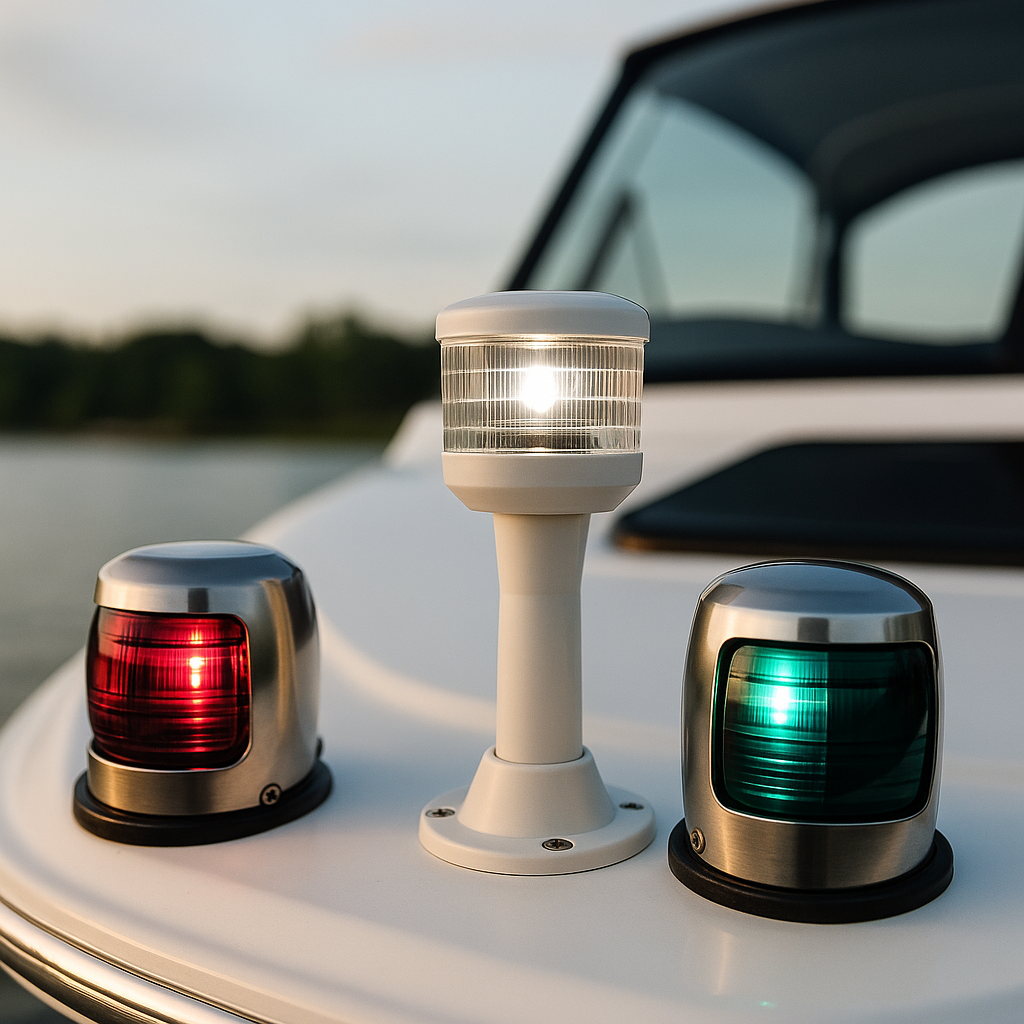
- Red sidelight: visible on the port side
- Green sidelight: visible on the starboard side
- White stern light: visible from the rear
- White masthead or all-round light: depending on vessel type and setup
- Anchor light: white light visible 360 degrees when anchored, where required
On many recreational boats under 12 meters, the setup often includes red and green sidelights plus either:
- A separate stern light and masthead light, or
- A combined all-round white light, depending on vessel design and legal application
Because regulations can vary by vessel type and operating condition, we should always verify requirements for our boat with current U.S. Coast Guard rules and any local regulations.
Safety and Compliance Basics
When manufacturers say a light is compliant, that should mean more than marketing language. We should look for clear statements about:
- USCG compliance
- COLREGS visibility standards
- ABYC compatibility or marine-use suitability
- Specified visibility range, such as 1 nautical mile, 2 nautical miles, or more
- Correct color output, especially true red and green sectors
- Correct beam angle and arc of visibility
A navigation light is only compliant if it is installed and used correctly. Even a certified fixture can become non-compliant if we mount it at the wrong height, block it with gear, or pair it with the wrong companion light.
That is why buying the best LED navigation lights is not just about brightness. It is about choosing the correct fixture for our hull layout and intended use.
Types of LED Navigation Lights
Bi-Color Bow Lights
Bi-color lights combine the red and green sidelights into one fixture mounted at the bow. They are common on smaller powerboats and can simplify installation. We often choose these when space is limited or when replacing an older combination fixture.
Best for:
- Small center consoles
- Jon boats
- Aluminum fishing boats
- Compact runabouts
Separate Port and Starboard Sidelights
These lights are mounted independently on each side of the bow or forward hull. They can provide a cleaner fit on boats where the bow shape does not work well with a center-mounted bi-color fixture.
Best for:
- Sailboats
- Larger powerboats
- Boats with rail or hull-side mounting points
Stern Lights
A stern light is a white light visible from aft. On some boats, it works alongside a masthead light. On smaller recreational boats, we may instead use an all-round white light in the proper configuration.
Best for:
- Boats with standard navigation light layouts
- Replacing existing stern fixtures
All-Round White Lights
These 360-degree lights are commonly mounted on a pole at the stern and are especially popular on fishing boats, pontoons, and smaller outboard-powered boats. Many are removable for storage and trailering.
Best for:
- Bass boats
- Pontoons
- Skiffs
- Small recreational boats
Specialty and Low-Profile Lights
Some modern boats benefit from flush-mount or low-profile LED fixtures that reduce snag points and improve appearance. These can be excellent options when we want a clean look without sacrificing visibility.
Best for:
- Newer fiberglass boats
- Performance boats
- Owners doing cosmetic upgrades
How We Choose the Best LED Navigation Lights
1. Start With Our Boat Type and Length
Boat length affects the required visibility range and legal configuration. A light that works on a small inland skiff may not be appropriate for a larger coastal cruiser. Before buying, we should confirm:
- Vessel length
- Power or sail configuration
- Existing mounting locations
- Whether we need a direct replacement or full system upgrade
2. Match the Light to the Required Arc and Position
Navigation lights are directional by design. Red and green sidelights must cover specific sectors, and white lights must also meet visibility arc requirements. We should never assume a generic LED light bar or utility light can substitute for a certified nav light.
3. Choose Marine-Grade Materials
Freshwater boaters can sometimes get away with lower-cost fixtures for a while, but saltwater exposes weaknesses quickly. For long-term value, we should prioritize:
- Stainless steel hardware
- Sealed electronics
- Corrosion-resistant bases
- UV-resistant lenses and housings
4. Evaluate Brightness the Right Way
Brighter is not always better if the beam pattern is wrong or if glare becomes a problem. What matters most is compliant visibility at the proper angle and distance. We should trust rated visibility and certification over vague lumen claims.
5. Consider Wiring and Mount Compatibility
Replacement projects are easier when the new fixture matches the old hole pattern, footprint, and wiring path. If we are upgrading from incandescent to LED, we should check:
- Voltage compatibility
- Two-wire or three-wire design
- Pole base style
- Mounting screw spacing
- Required sealant or backing plate
6. Think About Storage and Trailering
Tall stern or all-round pole lights can be vulnerable during transport. Removable plug-in designs are often a smart choice for trailer boaters because they reduce breakage risk and make storage easier.
Key Features to Look For
Visibility Rating
A navigation light should clearly state its certified visibility range. This is one of the most important specifications because it directly affects compliance.
Sealed Construction
Moisture intrusion is one of the most common causes of marine light failure. A sealed LED unit generally lasts longer and requires less maintenance than a fixture with weak gaskets or exposed contacts.
Low Current Draw
One of the biggest reasons we switch to LED is efficiency. Low draw matters on boats with limited battery reserves, especially when we spend long hours drifting, trolling, or anchored.
Durable Lens and Housing
Sun exposure, salt, impact, and vibration all take a toll. A good marine navigation light should be built for outdoor abuse, not just occasional splash resistance.
Easy Installation
Some fixtures are much easier to install than others. If we are replacing an existing setup, plug-and-play compatibility can save time and reduce wiring mistakes.
Common Buying Mistakes to Avoid
Even experienced boaters can make errors when shopping for navigation lights. Here are the most common pitfalls:
- Buying decorative LEDs instead of compliant navigation lights
- Choosing lights based only on brightness claims
- Ignoring boat-length visibility requirements
- Mixing incompatible fixtures from different systems
- Forgetting about corrosion resistance in saltwater
- Installing lights where rails, motors, or gear block visibility
- Using cheap wiring connectors that fail in wet conditions
Avoiding these mistakes can save us from failed inspections, on-water safety issues, and repeat replacement costs.
Best Use Cases by Boat Style
Small Fishing Boats and Jon Boats
We usually want simple, rugged, low-draw fixtures that are easy to wire and resistant to vibration. A bi-color bow light and removable all-round stern pole are often practical choices.
Pontoons
Pontoons benefit from visible, elevated all-round white lights and durable sidelights that can handle frequent docking and cover use. Corrosion-resistant hardware is especially important.
Center Consoles
Center consoles often need compact, low-profile sidelights and reliable stern or all-round lighting that will not interfere with fishing or casting.
Sailboats
Sailboats may require more specialized placement depending on rigging and configuration. We should pay close attention to compliance for side, stern, masthead, and anchor lighting.
Coastal and Saltwater Boats
In saltwater, premium materials matter. Better seals, better metal finishes, and better wiring protection usually justify the extra cost.
How to Install LED Navigation Lights
If we are replacing or upgrading our lights, careful installation is just as important as choosing the right product.
1. Disconnect Power
We start by turning off the battery switch or disconnecting the battery to prevent shorts and accidental damage.
2. Confirm the Correct Light Type and Location
Before mounting anything, we verify which fixture belongs at the bow, stern, or anchor position and confirm the required orientation.
3. Remove the Old Fixture
We unscrew the old light carefully, inspect the wiring, and check for signs of corrosion, water intrusion, or damaged sealant.
4. Test the New Light Before Mounting
We connect the new fixture temporarily to confirm it powers on correctly before sealing it in place.
5. Prepare the Mounting Surface
We clean the area, remove old sealant, and make sure the surface is dry and smooth. If necessary, we fill abandoned holes properly.
6. Make Marine-Grade Electrical Connections
We use heat-shrink marine connectors or properly sealed terminals, not household wire nuts or low-grade crimp fittings.
7. Apply Marine Sealant
We seal screw holes and fixture bases as needed to help prevent water intrusion into the deck or hull.
8. Mount and Align the Fixture
We secure the light firmly and make sure it is aimed and positioned according to the manufacturer’s instructions and legal requirements.
9. Restore Power and Test at Night
Once installed, we restore power and verify operation in low-light conditions so we can confirm visibility and check for glare or obstruction.
Maintenance Tips for Longer Service Life
LED navigation lights are low maintenance, but they are not maintenance-free. We can extend service life by doing a few simple checks:
- Rinse salt spray off fixtures after use
- Inspect wiring and connectors periodically
- Clean lenses to maintain brightness and color clarity
- Check mounting screws for looseness
- Replace cracked lenses or corroded bases promptly
- Test all navigation lights before every night trip
A two-minute pre-departure light check is one of the easiest safety habits we can build.
Are Expensive LED Navigation Lights Worth It?
In many cases, yes. Premium lights often provide:
- Better sealing n- More reliable compliance standards
- Stronger corrosion resistance
- Longer warranties
- Cleaner beam control and color accuracy
- Better hardware and easier installation
That does not mean we always need the most expensive option. For occasional freshwater use, a mid-range marine-certified light may be more than enough. But for frequent night operation, offshore use, or saltwater exposure, paying more upfront often saves money over time.
Our Final Buying Advice
The best LED navigation lights are the ones that match our boat, meet legal requirements, and hold up in our actual boating conditions. We should focus less on flashy marketing and more on certified visibility, proper fixture type, marine-grade durability, and installation fit.
If we boat after sunset, before sunrise, in fog, or in busy waterways, navigation lights are critical safety gear. A quality LED setup improves visibility, reduces battery strain, and gives us more confidence every time we leave the dock.
When we evaluate the best led navigation lights, the smartest approach is to start with compliance, then narrow our options by mounting style, materials, and long-term durability. That is how we make a purchase that supports both safety and value.
FAQ
What are the best LED navigation lights for boats?
The best LED navigation lights are marine-certified fixtures that match our boat’s size and layout, provide the required visibility range, and use corrosion-resistant materials. The right choice depends on whether we need a bi-color bow light, separate sidelights, a stern light, or an all-round white light.
Are LED navigation lights legal on boats?
Yes, LED navigation lights are legal as long as they meet applicable U.S. Coast Guard and navigation rule requirements for color, visibility range, arc, and placement. We should always verify the manufacturer’s compliance claims and install them correctly.
How many navigation lights does a boat need?
That depends on boat type, size, and whether we are underway or anchored. Many small recreational boats use red and green sidelights plus a white stern or all-round light, but exact requirements vary.
How long do LED boat navigation lights last?
Quality LED navigation lights can last many years, often far longer than incandescent bulbs. Actual lifespan depends on sealing, vibration resistance, wiring quality, and exposure to saltwater and UV.
Can we replace incandescent navigation lights with LED lights?
Yes, in many cases we can replace incandescent fixtures with LED models. We should make sure the replacement is marine-certified, fits the mounting location, and meets the same legal requirements as the original setup.
What is the difference between an anchor light and a navigation light?
An anchor light is a white 360-degree light displayed when the boat is anchored, where required. Navigation lights generally refer to the running-light configuration used when the boat is underway.
Do brighter navigation lights mean safer navigation?
Not necessarily. Proper color, beam angle, arc of visibility, and certified range matter more than raw brightness. A non-compliant bright light can still be unsafe or illegal.
What should we look for in saltwater boat navigation lights?
For saltwater use, we should prioritize sealed housings, stainless or corrosion-resistant hardware, UV-stable lenses, marine-grade wiring, and strong manufacturer support or warranty.
Get your free Get Our Free Boat Gear Checklist
The essential marine gear list every boater should have before hitting the water.