Best Fish Finders for Kayaks: Compact and Powerful (2026)

Alana Azzouz is a Senior Editor at Searchshop Media Network with over a decade of experience in consumer content quality and editorial standards. She has reviewed thousands of product guides, buying articles, and comp…
✎ Reviewed by Alana Azzouz — Senior Editor
Why trust us
TopBoatGear articles are researched by the Searchshop Editorial team using manufacturer specs, marine industry sources, and owner feedback. Our goal is simple: when a boater searches for gear, the recommendations they read online should match what a knowledgeable dealer or experienced owner would actually suggest. We may earn a commission on qualifying affiliate purchases; it doesn't influence what we recommend — if a product changes or a better option comes along, the article changes too.
How We Evaluated
We researched the top options, comparing them across key factors including performance, value, ease of use, and reliability. Our recommendations are based on editorial evaluation of verified specifications, owner-reported real-world performance, and domain expertise.
Best Fish Finders for Kayaks: Compact and Powerful
If you're searching for the best fish finder for kayak fishing, the challenge is balancing power, screen clarity, battery draw, and a mount-friendly design that works in a small cockpit. We researched and compared leading compact sonar units with kayak anglers in mind, focusing on portability, ease of installation, GPS mapping, and real-world value. Whether you fish ponds, rivers, inshore flats, or larger lakes, the right fish finder can help you spend less time searching and more time catching.
Kayak anglers have different needs than bass boat owners. Space is limited, battery capacity matters more, and every accessory needs to justify its footprint. That is why we recommend compact units with bright displays, efficient power use, and straightforward controls.
Side-by-Side Comparison: Which One Should You Buy?

| Feature | Garmin Striker Vivid 4cv | Humminbird HELIX 5 G3 | Lowrance Hook Reveal 5 | Garmin Striker Vivid 7cv | Deeper PRO+ 2 |
|---|---|---|---|---|---|
| Best Use | Balanced kayak setup | GPS and maps | Easy fish targeting | Large-screen kayak rigs | Portable/no-drill use |
| Portability | Excellent | Good | Good | Fair | Excellent |
| Screen Readability | Good | Very good | Very good | Excellent | Depends on phone |
| Mapping | Basic waypoint GPS | Best here | Varies by model | Basic waypoint GPS | App-based |
| Installation Ease | Easy | Moderate | Moderate | Moderate | Easiest |
| Battery Efficiency | Excellent | Good | Good | Good | Very good |
| Value | Excellent | Very good | Very good | Good | Very good |
Clear Verdict
If we had to choose one model for the widest range of kayak anglers, we would pick the Garmin Striker Vivid 4cv. It offers the best balance of compact size, sonar performance, ease of use, and value.
If mapping is your top priority, go with the Humminbird HELIX 5 CHIRP GPS G3. If you want maximum portability and no permanent install, choose the Deeper PRO+ 2.
Quick Comparison Table
| Model | Best For | Screen Size | GPS/Maps | Sonar Highlights | Power Draw | Our Verdict |
|---|---|---|---|---|---|---|
| Garmin Striker Vivid 4cv | Overall value | 4 in | GPS waypoint marking | CHIRP + ClearVü | Low | Best overall for most kayak anglers |
| Humminbird HELIX 5 CHIRP GPS G3 | Mapping and versatility | 5 in | Full GPS mapping | CHIRP Dual Spectrum | Moderate | Best for serious anglers who want maps |
| Lowrance Hook Reveal 5 SplitShot | Easy fish finding | 5 in | GPS on select versions | FishReveal + DownScan | Moderate | Best for simple operation and target separation |
| Garmin Striker Vivid 7cv | Bigger screen on a kayak | 7 in | GPS waypoint marking | CHIRP + ClearVü | Moderate | Best large-screen option |
| Deeper PRO+ 2 | Ultra-portable and rental-friendly | App-based | Built-in GPS via app | Castable sonar | Very low onboard setup | Best no-drill option |
| HawkEye FishTrax 1C | Budget and basic depth finding | Small portable | No | Basic sonar | Very low | Best budget pick |
Our Top Picks at a Glance

Best Overall: Garmin Striker Vivid 4cv
We recommend the Garmin Striker Vivid 4cv for most kayak owners because it hits the sweet spot of size, price, sonar performance, and battery efficiency. It is compact enough for tight layouts but still gives a clear display and dependable CHIRP sonar.
Best Premium Pick: Humminbird HELIX 5 CHIRP GPS G3
If you want stronger navigation and mapping features, this is the one we would choose. It offers a larger screen and better route planning for anglers covering unfamiliar water.
Best Budget Pick: HawkEye FishTrax 1C
For casual anglers or first-time buyers, the FishTrax 1C offers a low-cost way to add depth and fish detection without building a full electronics setup.
Best Portable Pick: Deeper PRO+ 2
If you do not want to drill, wire, or permanently mount anything, the Deeper PRO+ 2 is a smart solution. It is especially useful for rental kayaks and minimalist anglers.
What We Looked For in the Best Kayak Fish Finders
When We researched these units, we focused on the factors that matter most on a kayak rather than on larger boats.
1. Compact Footprint
A kayak fish finder must fit in a limited space without getting in the way of paddling, pedaling, or landing fish.
2. Screen Visibility
Bright sunlight and water glare can make weak displays frustrating. We prioritized units with readable screens and good contrast.
3. Battery Efficiency
Kayak batteries are usually smaller than marine batteries on powerboats. Lower draw means longer days on the water.
4. Mounting Flexibility
We looked at how easily each unit can be mounted on tracks, rails, gear mounts, or portable arms.
5. Sonar Performance
We compared target separation, bottom tracking, shallow-water usefulness, and how easy it was to interpret the display while fishing.
6. GPS and Mapping
Not every kayak angler needs detailed charts, but waypoint marking and route tracking are very useful for returning to productive spots.
In-Depth Reviews
Garmin Striker Vivid 4cv
The Garmin Striker Vivid 4cv is our top recommendation because it feels purpose-built for kayak anglers who want reliable sonar without overcomplicating the setup. The 4-inch screen keeps the unit compact, while CHIRP sonar and ClearVü scanning provide enough detail to identify structure, drop-offs, and bait concentrations.
Pros
- Compact and easy to mount
- Excellent value for the features
- Clear display with vivid color palettes
- Low power draw for small batteries
- Simple interface for beginners
Cons
- No full mapping charts
- Smaller screen than 5-inch competitors
- Best for waypoint marking rather than advanced navigation
Who It's For
We think this is best for kayak anglers who want a dependable, compact fish finder for lakes, rivers, and inshore use without spending premium money.
Humminbird HELIX 5 CHIRP GPS G3
For anglers who prioritize navigation, the HELIX 5 CHIRP GPS G3 is one of the strongest choices in this class. The 5-inch display is noticeably easier to read than a 4-inch screen, especially when splitting views between sonar and maps. We liked its GPS features for marking offshore humps, channels, and repeat drifts.
Pros
- Strong GPS and mapping capability
- Larger, easy-to-read screen
- Good sonar detail and bottom definition
- Better for serious anglers exploring bigger water
Cons
- Larger footprint on smaller kayaks
- Higher price than entry-level models
- Slightly more power hungry
Who It's For
We recommend this model for experienced kayak anglers who fish larger lakes, reservoirs, or coastal areas and want better navigation confidence.
Lowrance Hook Reveal 5 SplitShot
The Hook Reveal 5 SplitShot is a user-friendly option that does a nice job helping anglers identify fish near structure. FishReveal combines sonar views in a way that many users find intuitive, and the 5-inch display is a practical size for kayaks that can accommodate a slightly larger head unit.
Pros
- Easy to use and quick to learn
- Helpful fish/structure separation
- Good 5-inch screen size
- Solid all-around performance
Cons
- Not as compact as 4-inch units
- Feature set varies by package/version
- Menus are not as simple as Garmin for some users
Who It's For
This is a great fit for anglers who want straightforward fish-finding performance and a mid-size display without jumping to a premium price tier.
Garmin Striker Vivid 7cv
Some kayak anglers want the biggest screen they can reasonably mount. If your kayak has enough room, the Striker Vivid 7cv gives you a major visibility upgrade. Split-screen use is much more practical here, and we found it easier to read while standing or drifting.
Pros
- Large, bright display
- Excellent readability at a glance
- Great sonar clarity for the price
- Useful for aging eyes or split-screen use
Cons
- Takes up more deck space
- Heavier and less minimalist
- More exposed to bumps and paddle strikes if mounted poorly
Who It's For
We recommend it for kayak owners with larger sit-on-top platforms, pedal kayaks, or electronics-focused fishing setups.
Deeper PRO+ 2
The Deeper PRO+ 2 is a different kind of fish finder. Instead of a traditional display head unit, it uses a castable sonar paired with your smartphone. For kayak anglers who value portability and flexibility, this can be a huge advantage. We especially like it for travel, rental kayaks, and anglers who fish from both shore and kayak.
Pros
- No permanent installation required
- Extremely portable
- Useful from shore, dock, or kayak
- Built-in GPS mapping through the app
Cons
- Relies on your phone screen and battery
- Not as seamless as a dedicated display in rough conditions
- App-based use is not for everyone
Who It's For
This is best for anglers who want a no-drill, multi-purpose sonar solution or who switch between different small craft regularly.
HawkEye FishTrax 1C
The FishTrax 1C is a basic, budget-friendly option for anglers who mainly want depth readings, temperature, and simple fish indication. It is not in the same class as the more advanced units above, but for the price, it can still be useful.
Pros
- Affordable
- Portable and simple
- Low power requirements
- Good for casual use
Cons
- Limited detail and features
- Small display
- Not ideal for advanced structure fishing
Who It's For
We recommend it for beginners, occasional anglers, or anyone who wants a simple depth finder for a small kayak setup.
How to Choose the Best Fish Finder for Kayak Fishing
Match the Screen Size to Your Kayak
A 4-inch unit works well on smaller kayaks and minimalist setups. A 5-inch screen is often the sweet spot if you have room. A 7-inch display is excellent, but only if your cockpit can handle it without feeling cluttered.
Decide Whether You Need Maps
If you fish small ponds or familiar water, waypoint marking may be enough. If you cover larger lakes, tidal creeks, or open water, full GPS mapping becomes much more valuable.
Think About Power Setup
Most kayak anglers use a compact 12V battery in a dry box or battery bag. Before buying, check the unit's power draw and estimate runtime for a full day on the water.
Consider Your Mounting Style
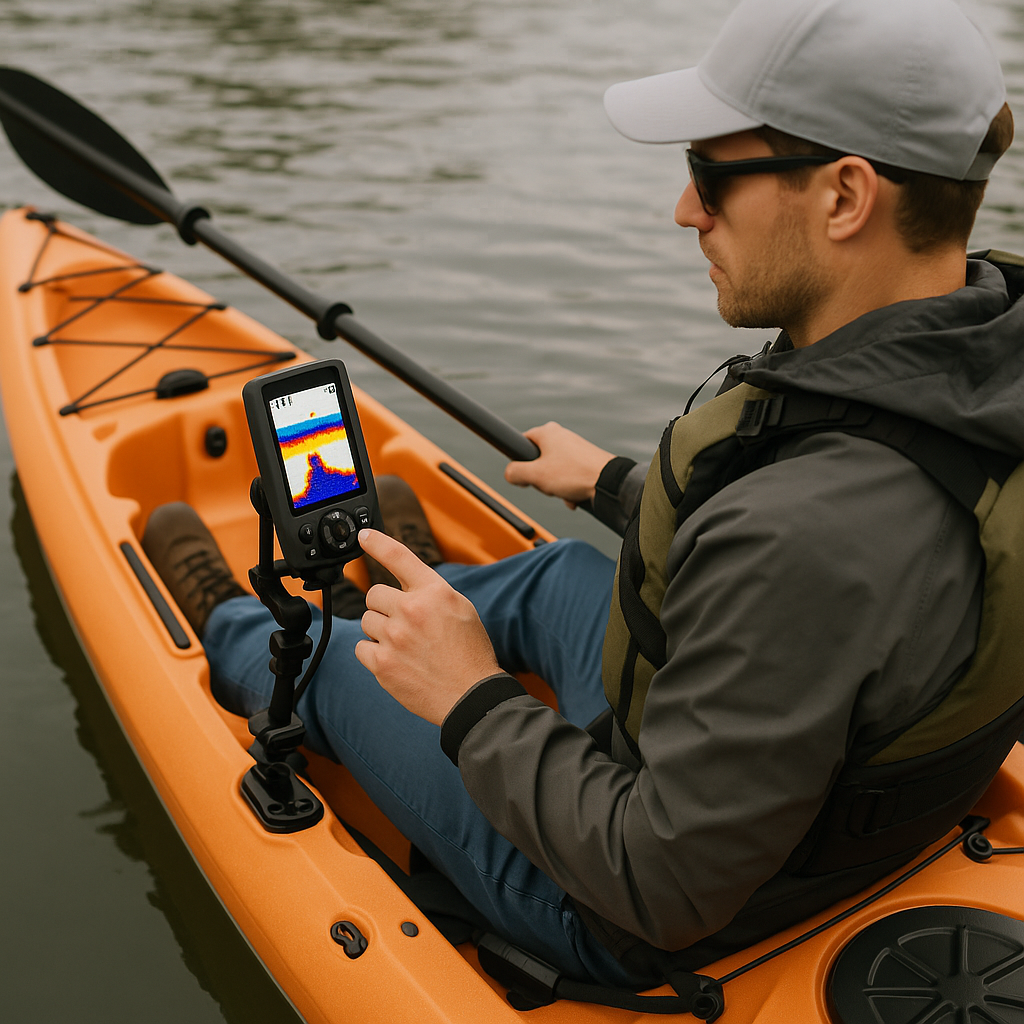
Track-mounted systems are the easiest to adjust and remove. Arm mounts make transducer placement simpler. Through-hull and scupper mounts can be cleaner but may require more planning.
Choose Sonar Based on Your Fishing Style
If you mostly want depth and bottom contour, basic CHIRP is enough. If you target brush piles, ledges, or suspended fish, down imaging or ClearVü/DownScan becomes more useful.
How to Install a Fish Finder on a Kayak
A kayak fish finder install can be straightforward if you keep it simple and plan your cable routing first.
Tools and Materials
- Fish finder head unit and transducer
- Kayak mount or track mount
- Battery and battery box or dry bag
- Marine-grade wiring and connectors
- Zip ties or cable clips
- Drill and bits if permanent mounting is needed
- Silicone or marine sealant
Numbered Installation Steps
- Choose the display location. We recommend placing it where you can read it easily without interfering with paddling or rod handling.
- Pick a transducer mount position. Common spots include a transducer arm, scupper mount, or inside-hull mount depending on your kayak and sonar type.
- Test cable routing. Run the cable path before fastening anything so you avoid sharp bends and snag points.
- Mount the display bracket. Use track systems if possible for easier adjustment and removal.
- Install the transducer. Make sure it sits level in the water and will remain submerged while underway.
- Connect the battery. Use waterproof connectors and secure the battery in a dry, stable location.
- Power on and test the unit. Check sonar readings in shallow water before heading out for a full trip.
- Tidy all wiring. Secure loose cables with zip ties or clips to prevent tangles and accidental pulls.
Safety Tips
- Keep wiring clear of footwells, pedals, and moving rudder parts.
- Use waterproof fittings and protect battery terminals from splashes.
- Do not mount the display where it could block re-entry or emergency movement.
- Check all mounts regularly, especially after transport or surf launches.
- Disconnect power before making wiring changes.
Common Mistakes to Avoid
Buying Too Large a Unit
A giant screen sounds appealing, but on a small kayak it can become awkward, vulnerable, and power-hungry.
Ignoring Battery Planning
Many first-time buyers focus only on the head unit and forget the practical side of powering it for a full day.
Overcomplicating the Install
We suggest starting with a clean, removable setup. You can always refine and expand it later.
Choosing Features You Will Never Use
Not every kayak angler needs advanced charting or premium imaging. Buy for the water you fish most often.
Final Verdict
After comparing these models, we believe the Garmin Striker Vivid 4cv is the best fish finder for kayak anglers overall. It is compact, efficient, easy to use, and powerful enough for most freshwater and light inshore fishing situations. It gives kayak owners the right mix of sonar performance and practicality without demanding a large battery or oversized mounting space.
For advanced navigation and mapping, we would step up to the Humminbird HELIX 5 CHIRP GPS G3. For anglers who want maximum portability or a no-drill solution, the Deeper PRO+ 2 is our favorite alternative.
The right choice depends on your kayak size, fishing style, and willingness to install electronics. But if you prioritize compact power and clean usability, these are the models we would shortlist first.
FAQ
What is the best fish finder for kayak beginners?
We usually recommend the Garmin Striker Vivid 4cv for beginners because it is compact, simple to learn, and offers excellent value without overwhelming menus.
Do I need GPS on a kayak fish finder?
Not always. If you fish small or familiar waters, basic sonar may be enough. But GPS is very useful for marking productive spots and safely navigating larger lakes or coastal areas.
How long will a kayak fish finder battery last?
That depends on the unit and battery size. Many compact fish finders can run all day on a small 12V battery if screen brightness and power draw are reasonable.
Can I install a fish finder without drilling my kayak?
Yes. Many anglers use track mounts, transducer arms, and portable battery boxes. Castable models like the Deeper PRO+ 2 are especially good for no-drill setups.
Is a 7-inch fish finder too big for a kayak?
It can be on smaller kayaks. On larger sit-on-top or pedal kayaks, a 7-inch unit can work very well. We recommend measuring your available mounting space before buying.
Get your free Get Our Free Boat Gear Checklist
The essential marine gear list every boater should have before hitting the water.